
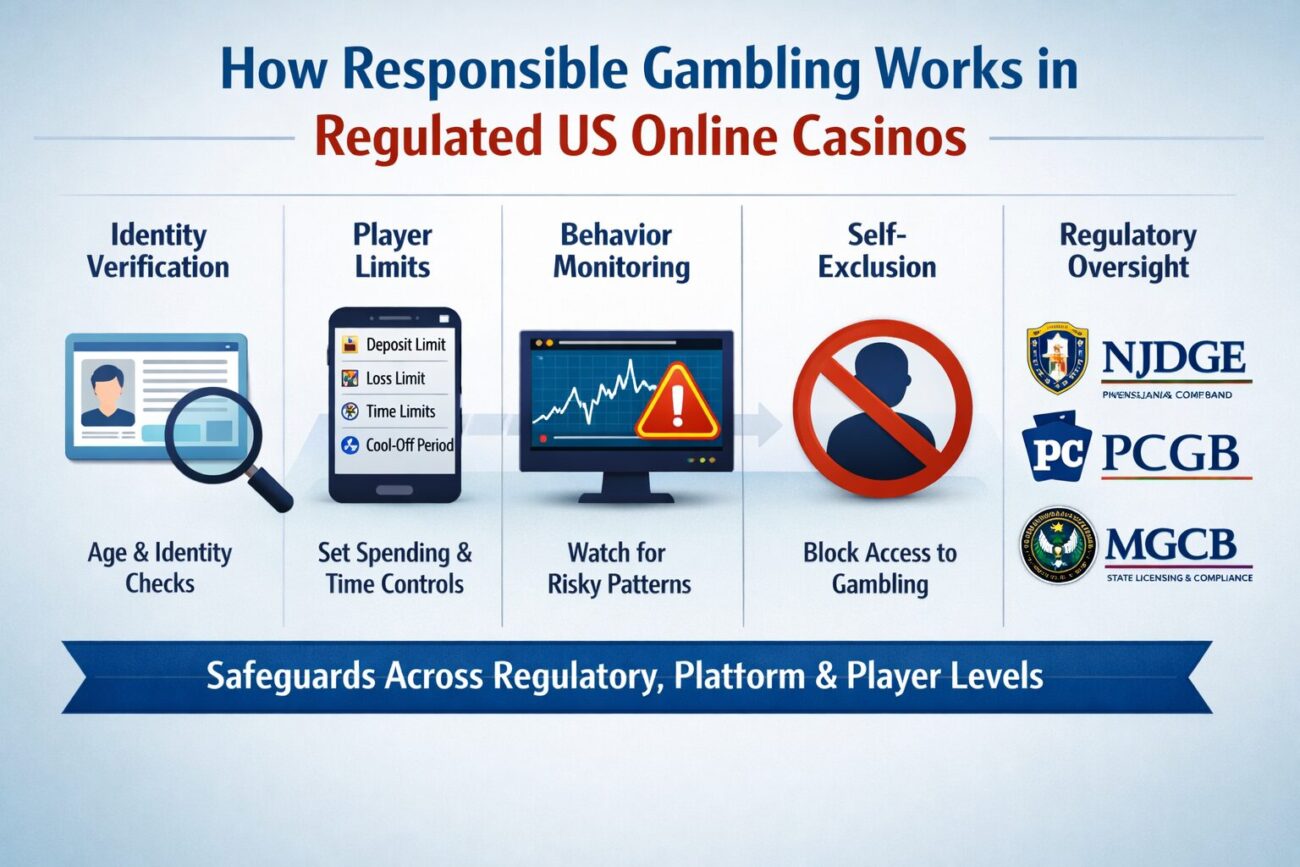
Responsible gambling is often presented as a matter of personal discipline, focused on setting limits or knowing when to stop. In regulated US online casino markets, however, player protection is also built into the system itself. Licensed operators are required to implement safeguards that form part of the regulatory framework, meaning responsible gambling is structured through rules, tools, and oversight rather than left solely to individual choice.
State regulators such as the New Jersey Division of Gaming Enforcement, the Pennsylvania Gaming Control Board, and the Michigan Gaming Control Board incorporate responsible gambling measures into licensing requirements. These measures influence how accounts are created, how play is monitored, and what controls must be available to users at US online casinos. As a result, responsible gambling in regulated environments operates across multiple layers, from identity verification to behavioural monitoring and intervention systems.
Understanding how these protections function helps clarify the difference between regulated online casinos and other environments. Player safeguards are not only recommendations or support resources. They are part of how the market is designed, reflecting a framework intended to manage risk while allowing legal online gambling to operate under supervision.
TL;DR: In regulated US online casinos, responsible gambling is built into the system rather than left solely to personal choice. State regulators require licensed operators to implement safeguards such as identity verification, player-set limits, behavioural monitoring, intervention procedures, and self-exclusion programs. These measures form part of licensing and compliance frameworks overseen by bodies like the New Jersey Division of Gaming Enforcement, the Pennsylvania Gaming Control Board, and the Michigan Gaming Control Board. Responsible gambling therefore operates across regulatory, platform, and player levels, reflecting how supervised markets are designed to manage risk alongside providing legal access to online gambling.
The Regulatory Layer: Why Safeguards Are Mandatory
In regulated US markets, responsible gambling measures are tied directly to licensing. Online casino operators are not simply encouraged to offer player protection tools. They are required to do so as part of the conditions for operating legally. State regulators set standards that platforms must meet, and these standards typically include policies, systems, and reporting processes related to responsible gambling.
Regulatory bodies such as the New Jersey Division of Gaming Enforcement, the Pennsylvania Gaming Control Board, and the Michigan Gaming Control Board incorporate player protection into their oversight frameworks. This can involve reviewing operator policies, auditing compliance systems, and requiring documented procedures for handling player risk indicators. Responsible gambling is therefore embedded within the broader compliance structure rather than treated as a standalone feature.
Because these measures form part of regulatory expectations, failure to maintain them can have operational consequences. Licensing is contingent on meeting established standards, and responsible gambling systems are included in that scope. This connection between player protection and regulatory compliance makes safeguards a structural element of the market, not just a voluntary add-on.
Identity and Age Verification Systems
One of the first responsible gambling safeguards in regulated US online casinos operates before play even begins. Identity and age verification systems are used to confirm that users meet legal requirements, satisfy Anti-Money Laundering (AML) and Know Your Customer (KYC) obligations, and ensure that accounts are tied to real individuals. These processes form part of broader compliance frameworks and help prevent underage gambling, identity misuse, financial fraud, and duplicate account creation.
Verification typically involves confirming personal details, checking identification information, and ensuring the player meets the minimum legal gambling age in their state. In regulated environments, these checks also support AML and KYC requirements by linking account activity to verified identities that can be monitored for compliance purposes. The objective is not only to satisfy legal eligibility standards but also to establish a traceable and secure account environment consistent with financial crime prevention rules.
This stage functions as an early control point within both the responsible gambling and financial compliance structures. It sets the foundation for later safeguards, including limit-setting tools, behavioural monitoring, and transaction analysis, by ensuring that accounts represent genuine, eligible users whose activity can be assessed against regulatory expectations. In regulated markets, identity verification therefore serves simultaneously as a licensing obligation, an AML/KYC control, and a core component of the broader player protection system.
Player-Control Tools Built Into Platforms
Regulated US online casinos are required to provide tools that allow players to manage their own gambling activity directly. These features give users the ability to set boundaries on spending and time, forming a core part of the responsible gambling framework. Rather than relying only on external advice, the system is designed so controls are available within the platform itself.
Common tools include deposit limits, which restrict how much money can be added to an account over a set period, and time-based limits that cap session length. Some platforms also offer loss limits, cooling-off periods, and temporary account restrictions that players can activate if they want a break. These mechanisms are integrated into account settings, making them part of the standard user environment in regulated markets.
Because these controls are embedded at the platform level, they operate continuously rather than as one-time interventions. They allow players to shape their own activity patterns within defined parameters, while also creating a framework that operators and regulators can reference as part of broader player protection policies. In this way, user-facing tools form one layer of a multi-tier responsible gambling system.
Behaviour Monitoring by Operators
In addition to player-controlled tools, regulated online casinos use internal systems to monitor patterns of play that may indicate elevated risk. These systems do not focus on individual wins or losses alone. Instead, they analyse behavioural indicators across sessions, looking for changes or patterns that fall outside typical activity ranges.
Examples of monitored signals can include unusually long sessions, rapid increases in deposit frequency, repeated attempts to raise limits, or shifts in betting patterns that suggest chasing losses. These indicators do not automatically imply a problem, but they help operators identify when a player’s activity may warrant attention within the responsible gambling framework.
When certain thresholds are reached, operators may initiate structured responses. These can range from automated messages that remind players of available tools, to account reviews or temporary restrictions depending on the circumstances and regulatory requirements. This monitoring layer functions as a backstop to player-controlled limits, adding an additional level of oversight within the broader protection system.
Self-Exclusion and Centralised Programs
Self-exclusion programs provide a more formal mechanism for players who want to step away from gambling entirely. In regulated US markets, these programs are often structured at the state level, allowing individuals to request that their access to licensed gambling platforms be restricted for a defined period. This can extend across multiple operators within the same jurisdiction rather than applying to a single account.
These systems are typically linked to regulatory oversight and are supported by organisations such as the National Council on Problem Gambling, which provides information and support resources. When a player enrolls in a state-run self-exclusion program, operators are required to block account access and prevent further participation during the exclusion term. The program may also cover land-based venues, depending on the state’s framework.
Self-exclusion represents a higher level of intervention than standard account limits. It is designed for situations where players want an enforced barrier rather than a voluntary control. As part of the broader responsible gambling system, these programs illustrate how regulation, operator systems, and support networks intersect to provide structured options for managing gambling behaviour.
Advertising and Communication Requirements
Responsible gambling in regulated US online casinos extends beyond gameplay tools and monitoring systems. Advertising and player communications are also subject to standards that require clear, visible messaging about gambling risks and support resources. Regulators expect operators to include responsible gambling information in promotional materials and on their platforms, making player protection part of how services are presented, not just how they operate behind the scenes.
These requirements often involve displaying links to help organisations, outlining available control tools, and avoiding messaging that could be interpreted as targeting vulnerable groups. Marketing is therefore part of the regulatory environment, with operators expected to balance commercial communication with clear information about risks and available safeguards.
By incorporating responsible gambling into communication practices, regulators and operators extend the protection framework into the broader user experience. The goal is not only to provide tools after issues arise, but also to ensure that awareness of limits and support options is integrated into how online gambling is promoted and explained.
What Happens When Safeguards Are Triggered
Responsible gambling systems are designed not only to detect risk indicators, but also to guide structured responses. When player-controlled limits are reached or behavioural monitoring systems identify patterns that meet predefined thresholds, operators may take steps that are built into their compliance procedures. These responses are intended to reduce risk while keeping actions proportionate to the situation.
Interventions can begin with automated notifications that remind players of available tools, such as deposit limits or cooling-off options. In some cases, operators may conduct account reviews or temporarily restrict certain functions while activity is assessed. These measures are applied within regulatory guidelines and are part of the operator’s obligation to maintain a safe operating environment.
This intervention process reflects how responsible gambling operates as an ongoing system rather than a one-time feature. Detection, communication, and action are linked, forming a framework that responds to player activity in real time. The aim is to manage risk through graduated measures, supported by both platform systems and regulatory expectations.
Why This Structure Exists
The multi-layered responsible gambling framework in regulated US online casinos reflects policy goals that go beyond individual platforms. Regulators aim to reduce gambling-related harm while maintaining a legal, supervised market. By embedding safeguards into licensing conditions, oversight systems, and platform design, the structure seeks to address risk at multiple points rather than relying on a single intervention.
This approach also supports market integrity. Clear standards for player protection help create consistent expectations across operators, ensuring that responsible gambling measures are not treated as competitive features but as baseline requirements. Oversight bodies can then evaluate compliance as part of broader regulatory duties, linking player protection to the stability and credibility of the market.
As a result, responsible gambling systems function as part of the regulatory architecture. They exist to balance access to legal online gambling with mechanisms intended to manage risk, reflecting how regulated environments are designed to operate under supervision rather than through purely voluntary practices.
How This Differs From Unregulated Environments
The responsible gambling structure described above is tied to licensing and regulatory oversight. In regulated US markets, operators must implement specific safeguards and can be reviewed on how those systems function. Player protection tools, monitoring procedures, and intervention processes are therefore embedded into the operating model as part of compliance.
In environments that do not operate under the same state regulatory frameworks, requirements may differ. The availability, scope, and enforcement of responsible gambling measures can vary depending on the legal and supervisory structure in place. Without the same licensing conditions and oversight mechanisms, safeguards may not be standardised across platforms.
This contrast highlights how responsible gambling systems are linked to the broader regulatory environment. In regulated markets, protections form part of the formal operating framework. Differences in oversight structures can lead to differences in how player protection tools and procedures are implemented, reinforcing the role of regulation in shaping responsible gambling practices.