
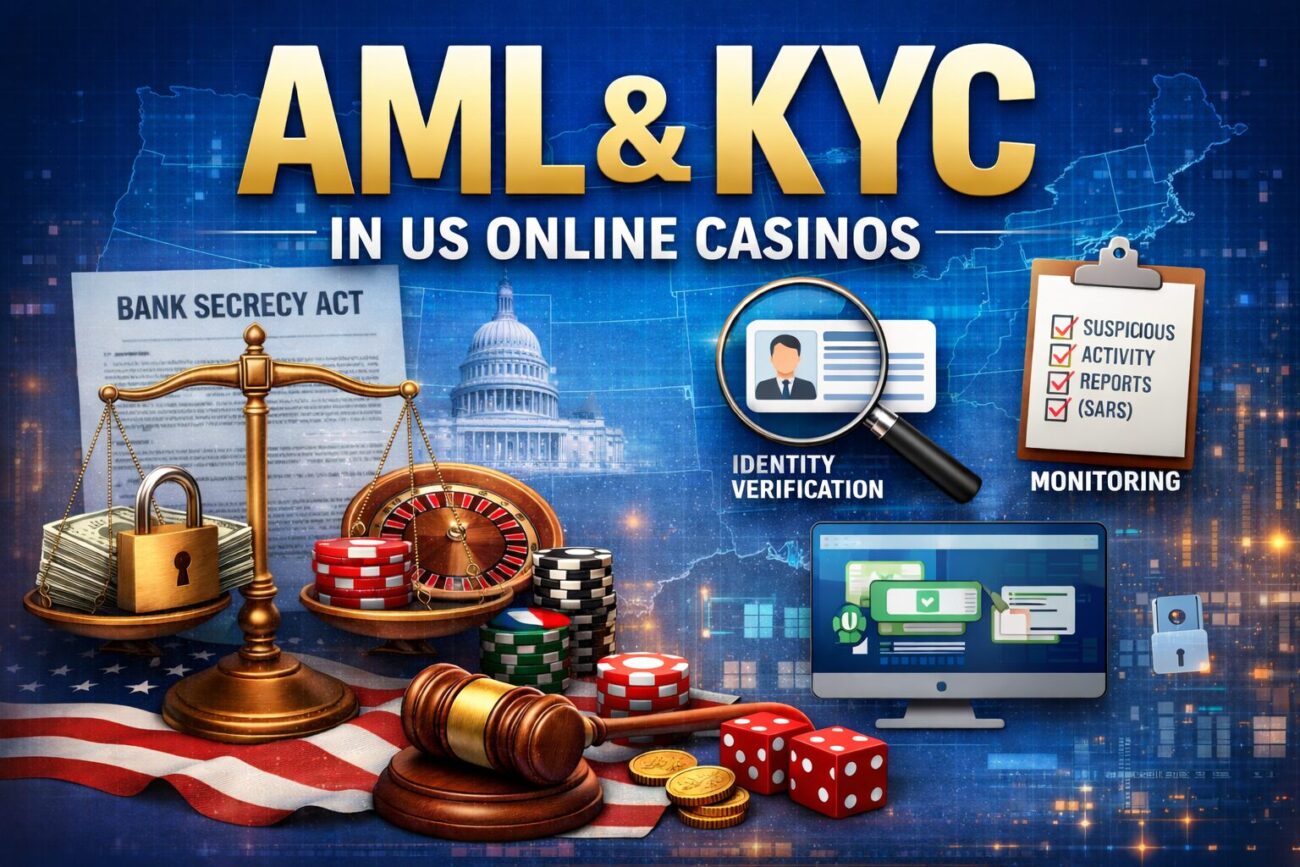
Players often experience identity checks, document requests, and withdrawal reviews as isolated inconveniences. In regulated US online casino markets, however, these processes are not discretionary platform choices. They reflect compliance obligations rooted in federal anti-money laundering law and incorporated into state gaming regulations.
Anti-Money Laundering (AML) and Know Your Customer (KYC) requirements shape how online casino accounts are created, monitored, and sometimes restricted. They influence everything from identity verification at registration to transaction monitoring, source-of-funds reviews, and the conditions under which withdrawals are processed. These systems are embedded within licensing frameworks overseen by state regulators and supported by federal financial crime standards.
Understanding AML and KYC requirements clarifies why regulated online casino accounts operate the way they do. Account verification, documentation requests, and risk reviews are not arbitrary safeguards. They form part of a broader compliance architecture designed to manage financial crime risk while allowing legal online gambling to function within supervised markets.
TL;DR: In regulated US online casinos, AML and KYC requirements are structural compliance obligations, not optional features. Federal anti-money laundering laws such as the Bank Secrecy Act and oversight by agencies like the Financial Crimes Enforcement Network influence how casinos verify identity, monitor transactions, and report suspicious activity. State regulators incorporate these requirements into licensing conditions, meaning account verification, withdrawal reviews, and monitoring systems are embedded into the regulatory framework rather than applied at random. These measures shape how online casino accounts are created, managed, and sometimes restricted in supervised markets.
What AML and KYC Actually Mean in Regulated Online Gambling
Anti-Money Laundering (AML) and Know Your Customer (KYC) are compliance frameworks designed to prevent financial crime within regulated markets. While these terms are often associated with banks, they also apply to gambling operators in jurisdictions where online casinos are licensed and supervised. In regulated US markets, licensed casinos must implement structured AML programs and customer verification procedures as part of their operating obligations.
AML refers to the systems and controls designed to detect and prevent money laundering, fraud, and other financial crimes. These controls typically include transaction monitoring, recordkeeping, risk assessment, and reporting mechanisms. In the United States, many of these standards originate from federal law, including the Bank Secrecy Act and guidance issued by the Financial Crimes Enforcement Network. Although online casinos are not traditional banks, certain gambling businesses fall within federal definitions that require them to maintain anti-money laundering programs.
KYC forms part of this broader framework. It refers specifically to the process of identifying and verifying customers before and during account use. This includes confirming identity, assessing risk profiles, and, in some cases, verifying the source of funds used for gambling. KYC is not a single document check at registration. It is an ongoing compliance function that supports AML monitoring by linking account activity to verified individuals.
In regulated online gambling environments, AML and KYC operate together. Identity verification establishes who the customer is, while transaction monitoring and risk assessment evaluate how the account is being used. Together, these systems form a structured compliance layer that shapes account design, monitoring practices, and intervention procedures within licensed markets.
The Federal Layer: The Bank Secrecy Act and FinCEN Oversight
AML obligations in US online gambling do not originate at the state level. They are grounded in federal financial crime legislation, most notably the Bank Secrecy Act. Enacted in 1970 and expanded through subsequent legislation including the USA PATRIOT Act, the BSA establishes recordkeeping, reporting, and anti-money laundering requirements for certain categories of financial institutions. These obligations exist alongside other federal statutes that shape online gambling activity, including the Wire Act and the Unlawful Internet Gambling Enforcement Act, which address interstate wagering transmission and payment processing respectively.
Oversight of AML requirements under the BSA is administered by the Financial Crimes Enforcement Network, a bureau of the US Department of the Treasury. FinCEN issues guidance, enforces compliance standards, and requires covered entities to implement written AML programs. Certain gambling businesses, including casinos above defined revenue thresholds, fall within the scope of these federal requirements. While the Wire Act focuses on specific forms of interstate wagering transmission and UIGEA targets financial intermediaries involved in unlawful internet gambling, the BSA framework establishes the compliance architecture that governs transaction monitoring and reporting.
Under the BSA, covered casinos must maintain internal controls designed to detect and prevent suspicious financial activity. This includes keeping detailed transaction records, conducting customer due diligence, and filing Suspicious Activity Reports when patterns suggest potential money laundering or other financial crime. These reporting obligations do not depend on whether criminal activity is ultimately proven. The threshold is based on reasonable suspicion under defined regulatory criteria.
This federal layer shapes how regulated online casino accounts are structured. Even where day-to-day gambling regulation is managed by state authorities, operators must design compliance systems that align with federal AML expectations. The Wire Act constrains certain forms of interstate transmission, UIGEA influences how payments are processed, and the BSA establishes reporting and monitoring standards. Transaction monitoring, documentation retention, and risk assessment protocols therefore reflect an interconnected federal framework that operates alongside state licensing regimes within regulated US gambling markets.
How State Regulators Incorporate AML and KYC Into Licensing
While federal law establishes baseline anti-money laundering obligations, state regulators incorporate AML and KYC requirements directly into online casino licensing frameworks. When a state legalises online gambling, it does not rely solely on federal standards. It requires operators to demonstrate that structured compliance programs are in place before granting approval to operate.
Regulatory bodies such as the New Jersey Division of Gaming Enforcement, the Pennsylvania Gaming Control Board, and the Michigan Gaming Control Board review compliance policies as part of the licensing process. Operators are typically required to submit written AML programs, designate compliance officers, maintain audit trails, and document internal controls for customer verification and transaction monitoring. These requirements are subject to inspection and review rather than left to informal implementation.
State-level oversight may include ongoing reporting obligations, independent audits, and system testing. Regulators can request documentation showing how suspicious activity is identified, how risk assessments are conducted, and how escalation procedures function in practice. AML and KYC are therefore embedded within the supervisory structure of regulated markets rather than treated as optional safeguards.
Because licensing is conditional on maintaining compliance standards, AML and KYC systems directly influence how online casino accounts operate. Identity checks, withdrawal reviews, and account restrictions are not ad hoc decisions made by customer support teams. They are features of a compliance framework that operators must maintain to preserve regulatory approval and continue operating legally within the state.
Identity Verification at Account Creation
The most visible expression of KYC requirements occurs at the point of account registration. Before a player can deposit or place wagers in a regulated US online casino, the operator must verify that the individual meets legal eligibility standards and that the identity associated with the account is genuine. This step functions as an initial compliance control rather than a customer service formality.
Verification typically includes confirmation of name, date of birth, residential address, and, in many cases, partial or full Social Security number information. These details are checked against third-party identity databases and public records to confirm accuracy and prevent duplicate or synthetic identities. Age verification is mandatory, as regulators require operators to block underage gambling before play begins.
This process supports both AML and state regulatory objectives. From a federal compliance perspective, linking account activity to a verified individual allows transaction monitoring systems to function effectively. From a state licensing perspective, identity verification ensures that gambling occurs only within the legal framework established by the jurisdiction. Without verified identity data, subsequent risk assessment and reporting mechanisms would lack a reliable foundation.
Identity verification also reduces certain types of fraud, including account takeovers, bonus abuse, and payment disputes. While these concerns are commercial in nature, they intersect with regulatory expectations around integrity and recordkeeping. As a result, the registration process in regulated online casinos reflects layered compliance requirements rather than simple account creation procedures.
Ongoing Monitoring and Risk Assessment
AML and KYC obligations do not end once an account is verified. In regulated US online casinos, compliance frameworks require ongoing monitoring of account activity to identify patterns that may indicate elevated financial crime risk. This monitoring is structured, systematic, and embedded within the platform’s operational systems rather than applied selectively.
Transaction monitoring systems review deposit frequency, withdrawal behaviour, betting patterns, and changes in activity levels over time. The objective is not to evaluate wins or losses in isolation, but to detect anomalies that fall outside expected behavioural ranges. Examples can include rapid cycling of funds with minimal gameplay, sudden increases in deposit size, repeated structuring of transactions below reporting thresholds, or activity inconsistent with previously established risk profiles.
When predefined internal thresholds are met, accounts may be flagged for review. This does not automatically imply wrongdoing. It triggers a compliance assessment process that may involve additional documentation requests, temporary withdrawal holds, or internal escalation to a compliance team. These procedures are designed to evaluate whether activity aligns with declared identity information and source-of-funds expectations.
Risk assessment models are typically risk-based rather than uniform. Higher-risk profiles may receive enhanced due diligence, while lower-risk accounts may experience minimal friction after initial verification. This tiered approach reflects federal AML guidance, which encourages proportional controls based on risk exposure. As a result, ongoing monitoring shapes how online casino accounts function over time, influencing when additional verification is requested and how account restrictions are applied within regulated markets.
Why Withdrawals Are Sometimes Delayed
Withdrawal delays in regulated online casinos are frequently attributed to operational inefficiency or platform discretion. In licensed US markets, however, withdrawal reviews are often connected to AML and KYC compliance obligations rather than simple processing timelines. Payouts represent a critical control point within the anti-money laundering framework because they involve the movement of funds out of the regulated system.
When a withdrawal request is submitted, operators may conduct additional checks to confirm that identity verification remains valid and that transaction patterns align with the account’s established risk profile. If deposits, gameplay behaviour, or payment methods have changed significantly since registration, compliance systems may require updated documentation before funds are released. This can include confirmation of identity, verification of payment instruments, or, in certain cases, source-of-funds documentation.
Source-of-funds reviews occur when transaction volume, deposit size, or account activity exceeds internal risk thresholds. Operators may request documentation demonstrating that deposited funds originate from legitimate and verifiable sources. These procedures are aligned with federal AML expectations and state regulatory requirements, particularly where transaction monitoring systems generate alerts.
Withdrawal holds are therefore not automatically punitive or discretionary. They function as part of a compliance checkpoint embedded within the account lifecycle. Because regulated casinos must maintain documented AML programs and demonstrate effective monitoring to state regulators, payout stages become natural moments for reassessment. The objective is to ensure that funds moving through the platform remain consistent with verified identity information and established compliance standards.
How AML and KYC Differ in Offshore Environments
AML and KYC obligations in regulated US markets are shaped by federal financial crime law and state licensing oversight. As discussed earlier, frameworks tied to the Financial Crimes Enforcement Network and the Bank Secrecy Act influence how licensed operators design monitoring systems, maintain records, and report suspicious activity. State regulators such as the New Jersey Division of Gaming Enforcement then incorporate these standards into licensing conditions. Offshore environments operate under a different jurisdictional structure.
Offshore casinos are licensed and supervised by foreign regulatory authorities rather than US state agencies. Their AML and KYC obligations are determined by the laws of the jurisdiction in which they are incorporated. Some offshore regulators impose structured compliance requirements, including identity verification and suspicious activity monitoring. Others apply lighter-touch supervision or different reporting thresholds. Oversight standards therefore vary by jurisdiction rather than aligning with US federal financial crime frameworks.
Because offshore operators do not hold US state licences and do not operate under US territorial authority, they are not directly supervised by US gaming regulators. Federal financial crime law primarily governs domestic financial institutions and covered entities operating within the United States. While US payment channels may still impose compliance friction, offshore operators themselves are generally accountable to the regulator in their licensing jurisdiction rather than to US agencies.
This difference in supervisory structure affects how account verification and monitoring function in practice. In regulated US markets, AML and KYC controls are embedded within a multi-layered system of federal expectations and state licensing oversight. Offshore models rely on the regulatory standards of their home jurisdiction, which may differ in documentation requirements, monitoring intensity, and enforcement mechanisms. The distinction reflects jurisdictional reach rather than platform preference, and it helps explain why account experiences can vary across regulatory environments.
Why This Compliance Structure Exists
The integration of AML and KYC requirements into online casino accounts reflects broader policy objectives that extend beyond gambling itself. Financial crime frameworks are designed to protect the integrity of the banking system, reduce opportunities for money laundering, and limit the movement of illicit funds through regulated institutions. When online casinos operate within licensed US markets, they become part of that wider financial ecosystem.
Gambling platforms process deposits, withdrawals, and transfers that intersect with banks, payment processors, and other regulated intermediaries. Without structured identity verification and transaction monitoring, casinos could be used as channels for disguising the origin of funds or layering financial transactions. AML and KYC obligations exist to mitigate these risks by requiring documented controls, reporting mechanisms, and audit trails.
From a regulatory perspective, embedding compliance requirements into licensing frameworks also supports market credibility. State regulators are tasked not only with overseeing gameplay fairness and consumer protection, but also with ensuring that licensed operators do not expose the jurisdiction to financial crime risk. Requiring documented AML programs and KYC systems allows regulators to demonstrate that licensed markets operate within recognised financial crime standards.
This structure therefore serves multiple functions. It aligns gambling platforms with federal anti-money laundering expectations, reinforces state-level oversight, and supports the stability of the broader financial system. Account verification processes, monitoring systems, and withdrawal reviews are practical expressions of these policy objectives rather than isolated administrative features.
Practical Implications for Players in Regulated Markets
For players using regulated US online casinos, AML and KYC requirements shape the account experience from registration through withdrawal. Identity verification at signup, periodic document requests, and transaction reviews are structural features of licensed markets rather than indicators of platform instability. These processes reflect compliance obligations that operators must maintain to preserve regulatory approval.
In practice, this means that documentation may be required at different stages of account use. While many accounts are verified automatically through database checks, higher transaction volumes or changes in activity patterns can trigger additional review. Providing accurate information at registration and maintaining consistency between payment methods and identity details reduces the likelihood of extended compliance checks.
Withdrawal timing can also be influenced by compliance procedures. Where transaction monitoring systems flag activity for review, operators may pause payouts until verification is complete. This is not unique to gambling platforms. Similar compliance controls exist across financial services industries that operate under anti-money laundering frameworks. The presence of these controls reflects regulatory integration rather than discretionary delay.
Understanding the compliance structure behind AML and KYC requirements helps clarify why regulated online casino accounts operate with defined checkpoints. The objective is not to create friction, but to maintain documented oversight within a licensed financial environment. These systems are part of how supervised markets function, shaping account management in ways that reflect federal expectations and state regulatory standards.
Conclusion: AML and KYC as Structural Features of Regulated Markets
AML and KYC requirements are not peripheral safeguards layered onto online casino platforms. In regulated US markets, they form part of the operational architecture that allows licensed gambling to function within federal financial crime standards and state supervisory frameworks. Identity verification, transaction monitoring, and withdrawal reviews are practical expressions of these embedded compliance obligations.
Federal anti-money laundering law establishes baseline expectations around recordkeeping, reporting, and risk assessment. State regulators then incorporate those expectations into licensing conditions, requiring operators to maintain documented compliance programs and internal controls. Online casino accounts are therefore structured around verification and monitoring systems from the outset rather than adjusted after issues arise.
This framework explains why regulated accounts involve checkpoints at registration, during gameplay, and at payout stages. Each point serves a compliance function tied to broader oversight objectives. While these processes can introduce friction in certain circumstances, they reflect how licensed markets are designed to operate under supervision rather than discretion.
As long as online casinos remain integrated into regulated financial systems, AML and KYC requirements will continue to shape account design. They are not temporary measures or platform preferences. They are key components of a supervised gambling environment built to align with both state regulation and federal anti-money laundering standards.