
An online casino can offer an instant payment method and still take hours, or even days, to pay your withdrawal. The reason is simple: the payment method only controls part of the journey.
Open Banking, PayPal, Skrill, crypto, cards, and bank transfers all move money at different speeds once the casino sends it. Before that happens, the casino may still need to approve the request, complete account checks, review payment ownership, or process the withdrawal through its own queue.
This is why GamblersPro treats casino processing time and payment delivery time as separate parts of a payout. Looking at the casino payment method alone does not tell you how quickly the money will reach you.
How Fast Do Casino Payment Methods Move Money?
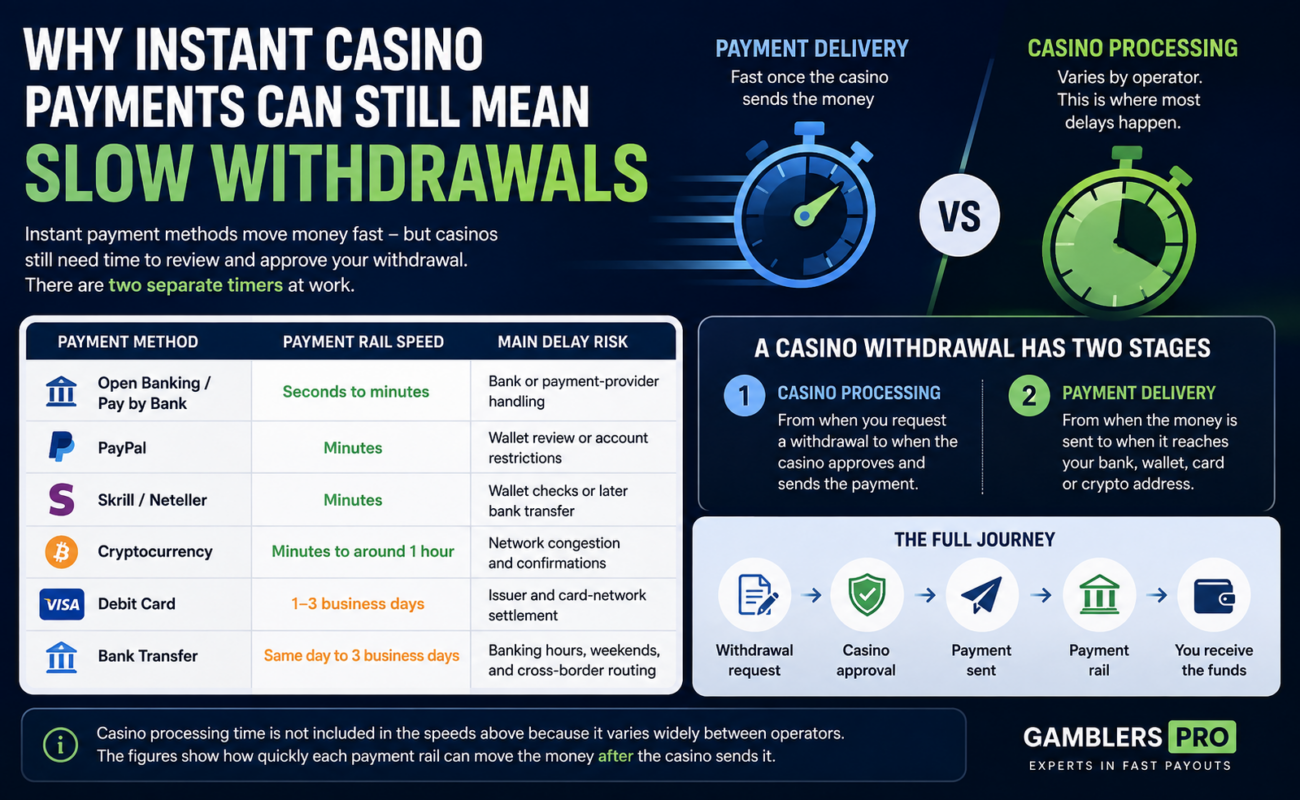
The table below compares the payment rails themselves after a casino has approved and sent the withdrawal.
| Payment Method | Payment Rail Speed | Main Delay Risk |
|---|---|---|
| Open Banking / Pay by Bank | Seconds to minutes | Bank or payment-provider handling |
| PayPal | Minutes | Wallet review or account restrictions |
| Skrill / Neteller | Minutes | Wallet checks or later bank transfer |
| Cryptocurrency | Minutes to around 1 hour | Network congestion and confirmations |
| Debit Card | 1–3 business days | Issuer and card-network settlement |
| Bank Transfer | Same day to 3 business days | Banking hours, weekends, and cross-border routing |
Casino processing time is not included because it varies widely between operators. A casino may approve a withdrawal in minutes or hold it for hours or longer before the payment method ever receives the transaction. The figures above show how quickly each payment rail can move the money after the casino sends it.
This is the part many players miss. A casino advertising crypto, PayPal, or Pay by Bank is showing you how the money can travel, not necessarily how quickly the operator will release it.
A Casino Withdrawal Has Two Separate Timers
The easiest way to understand payout speed is to split a withdrawal into two stages.
The first is casino processing time. This begins when you press Withdraw and ends when the casino approves and sends the payment.
The second is payment delivery time. This begins once the casino releases the money and ends when it reaches your bank, wallet, card, or crypto address.
So the full journey looks like this:
Withdrawal request → casino approval → payment sent → payment rail → player receives funds.
If the casino approves a PayPal withdrawal in 15 minutes and PayPal delivers it shortly afterwards, the whole payout can be very fast. If another casino holds the same request for 24 hours before sending it, PayPal has not become slower; the delay happened before PayPal received the payment.
That is why the phrase “instant withdrawal” needs context.
Open Banking Can Move Fast, but the Casino Still Goes First
Open Banking and Pay by Bank are good examples of the difference between payment speed and casino speed.
These services can connect a casino directly with a player’s bank account through an authorised payment provider. The player approves the transaction through their normal banking app, and the underlying account-to-account payment can move very quickly.
This makes Open Banking especially useful at regulated UK and European casinos, where direct bank payments are becoming more common. Deposits can be confirmed almost immediately, while withdrawals can move quickly once the operator releases them.
The casino still controls the first part. If its withdrawal process takes half a day, a payment rail capable of moving money in seconds cannot recover those lost hours.
For more on how the system works, see our guide to Open Banking casinos and Pay by Bank payments.
PayPal, Skrill, and Neteller Are Fast After Approval
E-wallets are another payment type where the delivery stage can be quick.
Once a casino sends money to PayPal, Skrill, or Neteller, the balance can appear much faster than a traditional card payout. This is one reason wallets have long been popular with players who care about withdrawal speed.
The important words are once the casino sends it. A casino may advertise PayPal withdrawals as fast because PayPal itself can move the money quickly. If the operator reviews withdrawals only once or twice a day, the player’s actual experience can still be much slower.
There can also be a second delay if you later transfer money from the wallet to your bank. The casino withdrawal may be complete, but the money has not necessarily reached your everyday account yet.
Crypto Has the Same Problem
Crypto is often described as an instant or near-instant casino payment method because blockchains can move funds without waiting for card networks or conventional bank transfers.
That can make crypto casinos very fast once the withdrawal is broadcast. Bitcoin, USDT, Litecoin, and other supported assets can move directly from the casino wallet to the player’s wallet, with the final speed depending on the network and confirmation requirements.
But the blockchain cannot approve a casino withdrawal for you. If you request USDT at 2pm and the casino does not approve it until 8pm, the six-hour delay happened before the blockchain was involved. A transaction that then reaches your wallet in minutes does not turn the overall payout into an instant one.
This is why simply saying “crypto payouts are fast” leaves out half the story.
Cards Can Add Delay After the Casino Pays
Debit cards work differently because the payment rail itself can take longer.
A casino may approve a card withdrawal quickly, but the return payment still has to move through the processor, card network, and issuing bank. That can add one to three business days even when there is no problem with the casino account.
Weekends and bank processing can stretch the wait further. This gives card withdrawals two possible sources of delay: the operator can take time to approve the payout, and the card system can then take additional time to deliver it.
For deposits, cards can feel instant. For withdrawals, the same technology can be much less impressive.
Bank Transfers Depend on the Banking System Being Used
Bank transfer is a broad term, and not every bank payment moves at the same speed.
A domestic Faster Payments transfer in the UK can behave very differently from an international wire crossing several banks. SEPA transfers in Europe also have a different settlement path from a conventional cross-border SWIFT payment.
That is why a casino listing “bank transfer” does not tell you enough on its own. You need to know which banking rail is being used and whether the payment is domestic, regional, or international.
The casino still has to approve the withdrawal first, but after that, the banking system becomes the main factor.
Why Casinos Do Not Release Every Withdrawal Immediately
There are several normal reasons a casino may spend time reviewing a withdrawal before sending it.
The operator may need to confirm that your account is verified, check that the payment method belongs to you, review a large or unusual transaction, or make sure any bonus conditions have been met. Some casinos also use fixed processing windows or withdrawal queues rather than releasing every request as soon as it arrives.
None of those steps makes the payment method itself slower. They happen before the transaction reaches the bank, wallet, card network, or blockchain.
This is why two casinos offering exactly the same payment method can have completely different payout speeds.
First Withdrawals Can Take Longer
The first withdrawal from a casino can be slower than later cash-outs because there is more to check.
The casino may need to verify your identity, confirm your address, review the payment method, or ask for proof that a bank account or wallet belongs to you. Once those checks have been completed, later withdrawals can move more smoothly if nothing changes.
Changing payment methods can create another delay. If you deposit with one method and suddenly request a withdrawal to a new bank account or wallet, the casino may need to verify the new destination before sending money to it.
This is one reason it helps to understand your withdrawal route before making the first deposit.
Why “Instant Deposit” Tells You Almost Nothing About Payout Speed
Casinos are very good at taking deposits quickly.
A card can be authorised in seconds. PayPal or Skrill can fund an account almost immediately, Open Banking can confirm a bank payment quickly, and crypto deposits can appear after the required network confirmations.
Withdrawals are different because money is leaving the casino. The operator may need to run checks before it releases the funds, and the payment method then has its own delivery time. A method that is excellent for instant deposits can therefore be average or slow when used for payouts.
This is also why players should be careful when judging a casino by its cashier logos alone. Seeing PayPal, Bitcoin, or Pay by Bank tells you what technology is available, but it does not tell you how the operator handles withdrawals.
How GamblersPro Looks at Fast Payouts
When comparing fast withdrawals, the useful measurement is the full journey from request to receipt.
That means looking at both:
- Casino processing – how long the operator takes before sending the withdrawal.
- Payment delivery – how long the chosen method takes once the money has been released.
This approach helps explain why a casino using a slower payment rail can sometimes beat a competitor using a faster one. An operator that approves withdrawals in ten minutes may still get the money to a player sooner than one using crypto but holding every request for 12 hours.
The fastest payment method and the fastest-paying casino are therefore not necessarily the same thing.
What to Check Before Choosing a Withdrawal Method
Start by checking whether the method works for withdrawals at all. Some casino payment options are designed mainly for deposits, so a fast way to put money in may leave you needing another route when you cash out.
Next, look for the casino’s stated processing time. If the operator says withdrawals can sit pending for up to 24 hours, that delay matters more than whether the final payment takes five minutes or thirty.
You should also check whether verification has already been completed. A fast payout method cannot help if the withdrawal is waiting for documents or payment ownership checks.
Finally, consider where you actually want the money to end up. A Skrill withdrawal may reach your wallet quickly, but if you then need another day to move it to your bank, the full journey is longer than the casino payout figure suggests.
Which Payment Method Gives You the Fastest Payout?
Crypto, Open Banking, PayPal, Skrill, and Neteller all have the potential to move money quickly after approval. Cards and conventional bank transfers tend to have longer delivery times, especially when several financial institutions are involved.
The casino itself can still outweigh those differences. A fast-paying operator using a one-day bank method can beat a slow operator using a blockchain that settles in minutes. This is why players looking for fast withdrawals should compare the operator’s processing policy alongside the payment method.
The best combination is simple: fast casino approval plus a fast payment rail.
The Bottom Line
An instant casino payment method does not guarantee an instant withdrawal because the payment method only controls the final part of the journey.
Open Banking, e-wallets, and crypto can all move money quickly once the casino releases it. Cards and conventional bank transfers generally need more time, but even the fastest rail cannot compensate for an operator that holds withdrawals in a long processing queue.
When comparing payout speed, look at the whole route: how long the casino takes to approve the request, then how long the bank, wallet, card network, or blockchain takes to deliver the money. That is the difference between a payment method that is fast on paper and a casino withdrawal that is actually fast in practice.
Gavin has spent over a decade writing about online casinos, with a focus on casino banking, fast withdrawals, payment methods, and how access differs between countries. He also spent five years working in the blockchain industry and has written more than 700 articles on cryptocurrency and blockchain, giving him specialist experience in crypto payments, wallets, stablecoins, and cross-border transactions.