
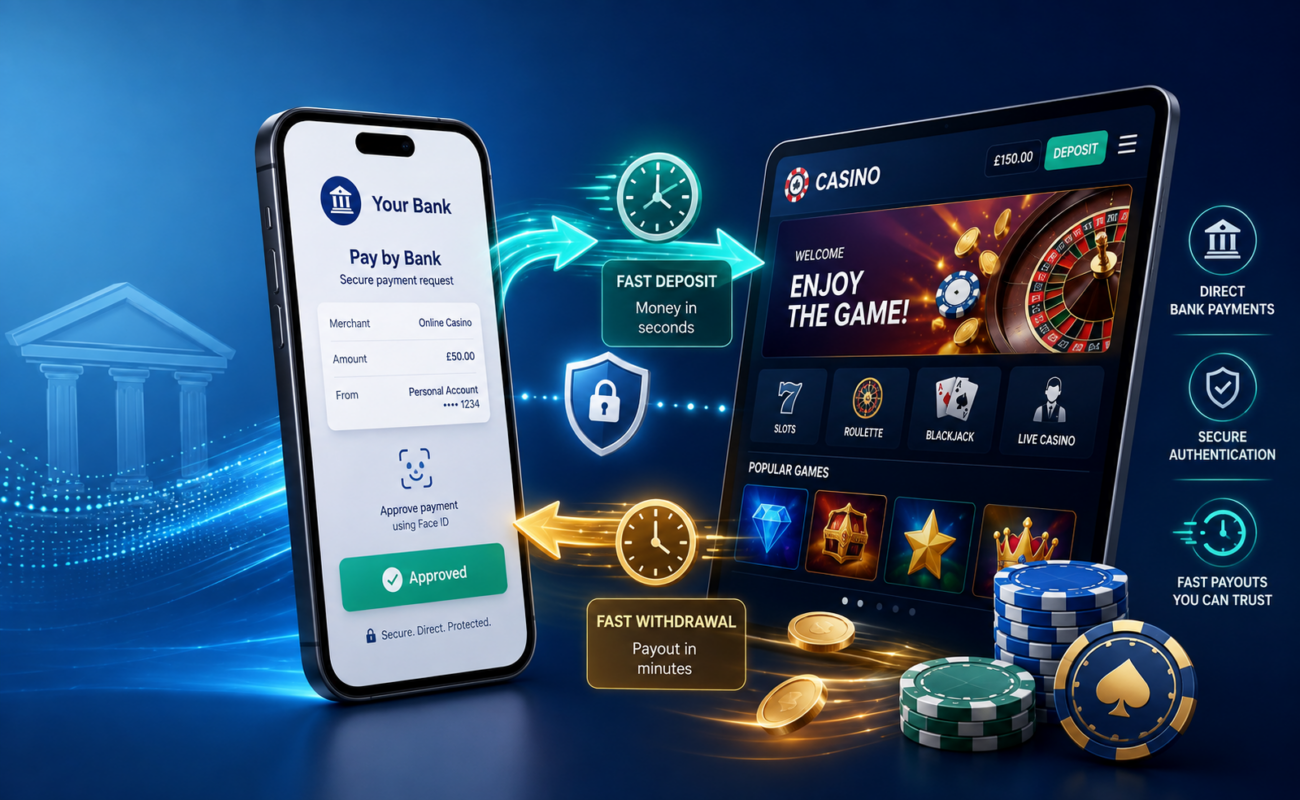
Pay by Bank is starting to change what a casino bank payment looks like. Instead of typing in card details or manually sending a bank transfer, players can choose their bank, approve the payment through their normal banking app, and return to the casino once it has been confirmed.
For players, the appeal is fairly simple. The money comes directly from a bank account, there is no card number to enter, and deposits can be confirmed almost immediately. The same account-to-account infrastructure can also support much faster movement of withdrawals than older banking methods, although the casino still has to approve the payout first.
Open banking is a particularly relevant in the UK and Europe, where casinos can already connect with mature banking systems and regulated payment providers. It is less prominent at offshore casinos, where crypto often performs a similar job outside the conventional banking system.
This guide explains how open banking works at online casinos, what Pay by Bank changes for deposits and withdrawals, and how it compares with cards, e-wallets, crypto, and traditional bank transfers.
What Is Open Banking at an Online Casino?
Open banking allows a customer to give an authorised payment provider permission to connect with their bank for a specific purpose. In the casino cashier, this normally appears as Pay by Bank, instant bank payment, or the name of a provider offering the service.
You do not hand your online banking password to the casino. Instead, you choose your bank and authenticate the payment through your bank’s own app or online banking system.
A typical casino deposit looks something like this:
Choose Pay by Bank → select your bank → approve the payment in your banking app → return to the casino
The payment is then sent directly from the bank account to the merchant through the underlying banking network.
In the UK, Open Banking Limited describes Pay by Bank as an account-to-account payment initiated with the customer’s consent and authenticated through their bank. Payments can move through Faster Payments rather than following the slower process associated with a conventional manual bank transfer.
The result is a bank payment that can feel much closer to using an e-wallet than filling out an old-fashioned bank transfer form.
Open Banking Casino Payments Compared
Open banking sits somewhere between a traditional bank transfer and the newer digital payment methods already common at online casinos.
| Payment Method | How You Pay | Typical Deposit Speed | Typical Withdrawal Speed |
|---|---|---|---|
| Open Banking / Pay by Bank | Approve directly through your banking app | Instant | Minutes to 1 day after casino approval |
| Skrill / Neteller | Pay through an e-wallet account | Instant | About 1 day |
| Crypto | Send from a crypto wallet | Minutes | About 1 hour after casino approval |
| Debit Card | Enter card details through the casino cashier | Instant | 3–5 business days |
| Traditional Bank Transfer | Send money through your bank | Same day to 3 business days | 2–5 business days |
*These figures are based on GamblersPro’s analysis of hundreds of online casinos across eight global regions, including our coverage of every country and US state. They are useful comparison figures rather than guaranteed payout times. Individual casinos, banks, payment providers, verification checks, weekends, and local payment systems can all affect the final result.
There is also an important difference between payment speed and casino processing speed. Open banking can provide a fast route between the casino and a bank account, but it cannot force an operator to approve a withdrawal quickly.
Why Open Banking Deposits Can Be So Fast
A traditional bank transfer involves several steps that the player may need to complete manually. You log into your bank, enter the recipient details and payment reference, make the transfer, then wait for the casino to recognise and match the payment to your account.
Open banking removes much of that work. The casino or payment provider can prepare the payment instruction, while the player simply selects the bank and authorises it.
The bank already knows who its customer is and can authenticate them through the same mobile app or security process used for everyday banking. Once approved, the transaction can be sent through a fast domestic payment network.
This reduces several sources of delay. There is less manual data entry, the casino can receive immediate confirmation of the transaction, and the payment is already connected to a recognised bank account.
For a player, it can feel almost as simple as an instant card payment without actually using the card network.
Does Open Banking Make Casino Withdrawals Faster?
It can, but this needs a little explanation.
Every casino withdrawal has two separate clocks running one after the other. The first is casino processing time. This starts when you request the withdrawal and ends when the casino approves and sends it. The second is payment time. This starts once the casino has sent the money and ends when it reaches your account.
Imagine a casino approves an open-banking withdrawal 20 minutes after you request it and the payment reaches your bank shortly afterwards. That is a genuinely fast casino payout.
Now imagine another casino uses the same underlying payment system but takes 24 hours to approve withdrawals. The banking technology has not become slower; the casino has added nearly an entire day before using it.
This is why GamblersPro’s casino banking coverage separates the speed of the payment method from the processing time imposed by the casino itself. A payment rail capable of moving money almost immediately does not guarantee an almost immediate withdrawal.
Pay by Bank vs a Normal Bank Transfer
The easiest way to understand Pay by Bank is to compare it with the bank transfer most people already know.
With a traditional transfer, you may be given the casino’s banking details and asked to send the money yourself. You need the correct account information and reference, and the recipient then has to match the payment with your casino account.
Pay by Bank turns that into an integrated checkout. You select your bank, approve a pre-prepared payment, and return to the casino. Because the transaction is created within the payment journey, there is less opportunity to enter the wrong account number, forget a reference, or send the wrong amount.
Both methods ultimately move money between bank accounts. The difference is how the transaction is initiated, authenticated, and connected to the casino cashier.
That helps explain why the term instant bank payment can be confusing. It is still a bank payment; it has simply been redesigned to behave more like a modern online checkout.
Open Banking vs Debit Cards
Cards remain one of the easiest ways to make an online payment. Enter the card number, expiry date, and security information, complete any required authentication, and the casino can confirm the deposit almost immediately.
Open banking reaches a similar result without routing the payment through Visa or Mastercard.
Instead, you authenticate directly with the bank. There is no need to enter a card number into the casino payment journey, and the transaction moves account-to-account rather than through the card network.
The biggest difference may appear when winnings come back. Cards are excellent at collecting payments, but returning casino winnings to them can be less straightforward. Support depends on the casino, payment processor, card network, and issuing bank, while card payouts can take several business days.
An account-to-account payment has a clear destination: the player’s bank account.
For players whose main concern is getting money back rather than getting money in, that can make the banking side of the cashier much more interesting.
Open Banking vs Skrill, Neteller, and PayPal
E-wallets solved many of the problems that open banking is now tackling long before bank APIs became widely available.
Skrill and Neteller allow a player to put a separate account between the casino and their everyday bank or card. Deposits are fast, withdrawals can return to the same wallet, and the player does not need to enter underlying bank details each time.
PayPal provides a similarly familiar payment layer at casinos where gambling transactions are supported.
Open banking removes the extra wallet.
Instead of:
Bank → e-wallet → casino.
the payment can become:
Bank → casino.
with an authorised payment provider managing the connection.
That can reduce the number of accounts involved, while e-wallets retain advantages for players who want to keep gambling funds separate or move balances between different services.
There is no universal winner. Both approaches provide much faster and cleaner payment journeys than the old model of manually sending bank transfers.
Why Open Banking Fits Licensed UK and European Casinos
Open banking works particularly well when the casino already has a formal relationship with the banking and payments system around it.
Across European online casino markets, regulated operators can make use of established banks, payment institutions, e-wallets, and account-to-account payment services. That creates a very different cashier from the one seen at many offshore casinos.
The UK is one of the clearest examples of how quickly the technology is developing. The FCA reported more than 16 million open-banking users by late 2025, while open-banking payments had increased 53% year-on-year. In June 2026, the FCA also announced the UK Payments Initiative as the next stage in developing commercial open-banking payments.
The UK government is now looking at open banking alongside tokenised and agentic payments as part of its wider modernisation of payment-services regulation.
For casinos, this matters because payments are increasingly becoming part of the regulated account infrastructure rather than a separate card transaction sitting on top of it.
Why Open Banking and KYC Fit Together
A fast payment is useful to a casino, but so is knowing that it came from the right person.
Casinos have to deal with third-party payments, stolen cards, fraud, account ownership, anti-money laundering checks, and situations where somebody attempts to withdraw money to an account belonging to someone else.
Open banking starts from an authenticated banking relationship. The customer approves access or payment through their own financial institution rather than simply supplying a string of card numbers to the casino.
That does not replace casino KYC. A gambling operator may still need identification, proof of address, source-of-funds information, or other documents depending on the player’s account and local rules.
It can, however, make the payment itself easier to connect with a recognised bank account. That is useful in a regulated industry where moving the money quickly and understanding where it came from both matter.
Open Banking and Crypto Solve a Similar Problem Very Differently
One of the more interesting patterns in global casino payments is that open banking and cryptocurrency can solve some of the same practical problems while taking almost opposite routes.
Both can provide fast two-way movement of money without relying heavily on card networks. Open banking does it by connecting the casino more closely to the regulated banking system. Crypto does it by allowing the casino and player to transact outside conventional bank and card rails.
Licensed UK and European casinos have strong reasons to integrate with domestic banking systems, regulated e-wallets, and open-banking providers. Offshore casinos serving players in markets such as the USA and Australia are much more likely to rely on Bitcoin, USDT, Litecoin, and other cryptocurrencies for two-way payments.
The end goal can look similar to the player: put money in quickly and get winnings back quickly. The infrastructure underneath is completely different.
Why Open Banking Could Become More Important for Withdrawals
Most of the early consumer attention around Pay by Bank has focused on checkout and deposits. That makes sense because payment initiation is where open banking first became visible.
The longer-term story is broader. The UK’s open-banking infrastructure is moving beyond simple one-off payments. Variable Recurring Payments, or VRPs, allow customers to give authorised providers permission to make payments within limits that have been agreed in advance. Customers retain control over those parameters rather than giving an unrestricted card-on-file instruction.
In June 2026, the FCA announced the UK Payments Initiative to support the commercial development of these services. The first scheme is intended to help move open banking beyond its original account-information and one-off-payment use cases.
Not all of this development is specifically about gambling, and it should not be presented that way. What it does show is that account-to-account payment infrastructure is becoming more capable.
For online casinos operating inside regulated banking environments, that creates more scope for the cashier to move away from cards and conventional transfers toward direct bank connections.
What Open Banking Does Not Fix
Open banking can make the payment rail faster, but there are still plenty of reasons a casino withdrawal might take longer than expected.
The casino may need to complete KYC, review a large transaction, check wagering conditions, confirm ownership of the payment account, or perform additional fraud and security checks.
The operator may also have a fixed processing period before withdrawals are released. If every request sits in a queue for 12 hours, changing the underlying bank rail cannot remove those 12 hours.
This is why advertised payment speeds need context. A provider saying that its bank transfer happens in seconds tells you how quickly the technology can move money. It does not necessarily tell you how long you will wait from pressing Withdraw to seeing the balance in your bank account.
When comparing casinos, the more useful figure is the total withdrawal time from request to receipt.
What Players Should Check Before Using Pay by Bank
Open banking makes the payment journey simpler, but it is still worth looking at the cashier before depositing.
First, check whether the bank method works for both deposits and withdrawals. Some casino payment methods are much better at one direction than the other, and there is little advantage in choosing an instant deposit if you later have to set up an entirely different payout method.
Next, check the casino’s withdrawal processing time. If the operator publishes an approval period separately from the payment-provider time, use both figures when judging how fast the payout is likely to be.
You should also check whether your own bank is supported. Open-banking coverage is broad in markets such as the UK, but individual payment services can support different sets of financial institutions.
Finally, remember that payment availability changes by country. A Pay by Bank service available at a British casino may not appear in another European market, while players elsewhere may have faster local alternatives.
The Bottom Line
Open banking turns the traditional bank transfer into something much closer to a modern digital payment. Players can approve transactions through their own bank, casinos can receive payment confirmation quickly, and account-to-account transfers remove some of the friction associated with cards and manual bank payments.
Its biggest advantage for casino players may eventually be the combination of speed and a clear two-way banking route. Fast deposits are already commonplace across the gambling industry; getting winnings back quickly is where payment systems differ much more noticeably.
Open banking cannot make a slow casino process withdrawals quickly. It can make sure the banking system is not the part holding things up once the casino decides to pay.
That is why Pay by Bank matters to the fast-withdrawal discussion. The fastest casino cashier is not simply the one that accepts an instant deposit. It is the one that combines quick casino approval with a payment rail capable of moving the winnings just as efficiently in the other direction.
Gavin has spent over a decade writing about online casinos, with a focus on casino banking, fast withdrawals, payment methods, and how access differs between countries. He also spent five years working in the blockchain industry and has written more than 700 articles on cryptocurrency and blockchain, giving him specialist experience in crypto payments, wallets, stablecoins, and cross-border transactions.