
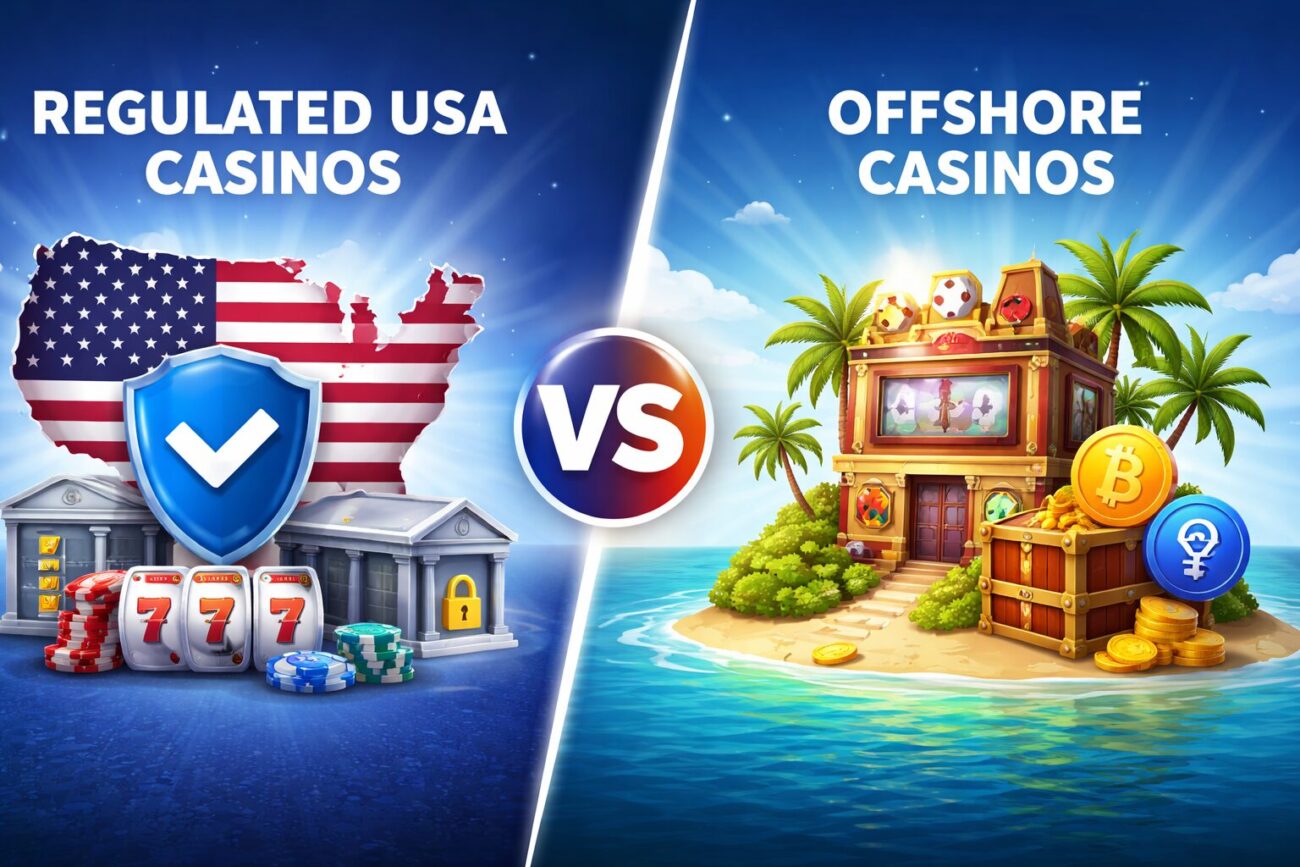
State-regulated online casinos in the United States compete inside a tightly controlled market.
They can compete on games, service, brand, loyalty, payments, and user experience, but they cannot change every part of the product freely.
State rules can shape promotions, payment systems, geographic access, game approval, account controls, and platform changes.
This creates a different competitive model from offshore gambling.
USA online casinos operating under state licences gain local legal access and regulatory trust, but they also accept limits on what they can offer and how quickly they can change it.
Offshore casinos face different constraints.
That means each model can compete strongly in some areas and less easily in others.
Regulation Changes the Competitive Space
The main difference is not simply that one group of casinos has more rules.
Regulation changes which competitive tools are available.
| Area | Regulated US Casino | Offshore Casino |
|---|---|---|
| Bonuses | Must fit state rules and disclosure requirements | Greater freedom to vary size and structure |
| Payments | Integrated with domestic banking and approved providers | Can rely more heavily on crypto and international processors |
| Geographic reach | Limited to approved jurisdictions | Can serve wider cross-border markets where accepted |
| Software changes | Subject to testing, controls, and approval processes | Can often deploy changes across markets more freely |
| Operations | Direct regulator oversight | Governed by the operator’s offshore licensing framework |
The result is not that one model can compete and the other cannot. They compete on different dimensions.
Regulated Casinos Cannot Compete Freely on Bonus Size
Promotions at regulated US casinos are part of the regulated gambling product.
Operators cannot treat a bonus as unrestricted advertising.
Terms such as eligibility, redemption, wagering conditions, and expiry must be clearly defined and available for regulatory review.
That changes how promotions are designed.
A casino can still offer:
- deposit matches;
- welcome bonuses;
- free spins;
- loyalty rewards;
- other incentives.
But the offer must work inside a formal compliance system.
Offshore Casinos Have More Room to Increase the Headline
Offshore casinos do not answer to US state regulators.
Their promotions are governed by their own licensing environment and internal rules.
That gives them more freedom to compete through:
- larger match percentages;
- larger maximum bonuses;
- more reload offers;
- more complex wagering structures;
- different cashout rules.
This helps explain why offshore bonuses can look much larger.
It does not mean they always provide more usable value. The terms still matter.
Regulated and Offshore Casinos Control Bonus Risk Differently
Every operator has to control the cost of promotions.
A regulated operator may do that by keeping the offer smaller and easier to explain.
An offshore operator can advertise a larger amount while controlling cost through:
- higher wagering requirements;
- game restrictions;
- maximum bet rules;
- maximum cashout;
- expiry conditions.
The difference is in how promotional risk is managed.
Regulated Casinos Cannot Compete on Unlimited Geographic Reach
State licensing creates one of the clearest limits.
A regulated casino can accept wagers only where it is legally authorised to do so.
Players must also be physically located in an approved jurisdiction when placing bets.
New Jersey rules, for example, require operators to detect player location and prevent internet gaming outside the state unless a permitted reciprocal arrangement applies.
This means a casino can be fully legal and operational while still being unavailable to most Americans.
A Licence Creates Access and a Border at the Same Time
A state licence does two things.
It gives the casino permission to operate, and it also defines where that permission ends.
This creates isolated regulated markets.
A player in New Jersey may have access to an operator that a player in a neighbouring state cannot use for online casino gaming.
The platform may be identical, but he legal access is not.
Offshore Casinos Compete Across Wider Geographic Markets
Offshore casinos often operate across multiple countries and US states from the same platform.
They are not working under individual US state casino licences.
That gives them a different geographic model.
One website can potentially serve players across a much wider area, subject to the operator’s own country restrictions and any local enforcement barriers.
This is one of the strongest structural advantages of the offshore model.
Geographic Reach Creates Scale
A regulated casino may compete for players in one state.
An offshore casino may draw players from:
- many US states;
- Canada;
- Latin America;
- Europe;
- other international markets.
That gives the offshore operator a larger possible acquisition pool.
The trade-off is that it does not gain the same local regulatory status in those markets.
Regulated Casinos Cannot Ignore Geolocation
Geolocation is not an optional product feature in regulated US online gambling.
It is part of market control.
The casino must know whether the player is physically inside the permitted jurisdiction.
That can require signals such as:
- GPS;
- Wi-Fi;
- IP information;
- device location data;
- specialist geolocation services.
Pennsylvania regulations likewise require interactive gaming to occur within the Commonwealth unless specific legal conditions allow otherwise.
Geolocation Creates Friction That Offshore Casinos May Not Have
A player at a regulated casino can be:
- logged in;
- fully verified;
- old enough to gamble;
- holding money in the account;
and still be unable to wager because the location check fails.
That is unusual compared with many offshore casinos.
The regulated operator cannot simply ignore the problem because geographic control is part of the licence.
Regulated Casinos Cannot Use Every Payment Method Freely
Payments are another area where domestic regulation shapes competition.
Regulated casinos work inside the US financial system.
That means payments can involve:
- banks;
- payment processors;
- KYC checks;
- AML controls;
- fraud systems;
- approved platform integrations.
The casino cannot simply connect any payment method it wants without considering the wider compliance system.
Domestic Banking Access Is Both an Advantage and a Constraint
This creates an interesting trade-off.
Regulated casinos can offer payment access through familiar US financial infrastructure.
That is useful for players.
But it also means the operator depends on financial institutions that apply their own risk and compliance controls.
A payment method therefore needs to work for:
- the casino;
- the regulator;
- the processor;
- the bank;
- the player.
That can narrow the available payment set.
ACH Fits the Regulated Model Well
ACH became an important gambling payment rail because it fits established US banking systems.
It provides a familiar bank-to-bank route and can be integrated into regulated account systems.
That makes it useful for compliance and domestic payments.
It does not necessarily make it the fastest possible payment method.
Offshore Casinos Can Compete on Payment Variety
Offshore casinos often support payment systems that sit outside standard US casino banking.
These can include:
- Bitcoin;
- stablecoins;
- other cryptocurrencies;
- international payment processors;
- alternative wallets.
That allows offshore operators to serve players who may have difficulty using domestic gambling payment rails.
It can also support faster settlement in some cases.
Crypto Creates a Different Payment Architecture
A crypto payment can remove some traditional intermediaries.
A withdrawal might move from:
- casino approval;
- casino wallet;
- blockchain;
- player wallet.
A traditional bank withdrawal can involve more institutions.
That difference can affect speed and flexibility.
It does not remove casino approval, KYC, or operator rules.
Regulated Casinos Cannot Deploy Every Game Immediately
Regulated US casinos can have very large game libraries.
The constraint is not simply the number of games.
It is how those games enter the market.
Game software and platform systems operate inside technical approval and testing frameworks.
Pennsylvania’s interactive gaming rules, for example, include standards for games, random number generators, software authentication, game changes, and submission of game rules for approval.
That means regulated software is built around approval.
Game Approval Creates a Deployment Pipeline
A simplified regulated process can look like this:
- A provider develops the game.
- The game enters technical testing.
- Required regulatory information is submitted.
- The game or system receives approval.
- The casino can make it available.
This process supports oversight.
It also means deployment cannot be based only on how quickly the casino wants to launch something.
Offshore Software Is Often Built for Reuse
Offshore casino software providers often build games and platforms that can be reused across many brands and countries.
The same content can appear across a large number of casinos.
That encourages:
- portable game libraries;
- shared platform systems;
- faster rollout across brands;
- greater cross-market consistency.
This is a different software model from repeated state-level approval.
Regulated Casinos Cannot Change Core Systems Without Oversight
The same principle applies beyond individual games.
Platform systems can include:
- payments;
- KYC;
- geolocation;
- responsible gambling;
- account management;
- security;
- game logic.
Changes to regulated systems may need testing, approval, documentation, or changes to approved internal controls.
Pennsylvania, for example, classifies integrated services such as geolocation, payment processing, and KYC within its interactive gaming regulatory structure.
This Creates a Speed Versus Control Trade-Off
A regulated operator may identify a useful new feature.
The question is not only: Can we build it?
It is also: Can we introduce it within the approved regulatory system?
That adds another stage between idea and deployment.
Offshore operators can often make operational changes with fewer US state-level dependencies.
Regulated Casinos Cannot Compete Through Rule Variation as Easily
State regulators create common minimum standards for operators inside the market.
That can cover areas such as:
- account creation;
- identity checks;
- location verification;
- responsible gambling;
- game integrity;
- promotional disclosure.
This reduces variation between regulated casinos in certain parts of the product.
That is deliberate.
The objective is to prevent important consumer protections from becoming optional competitive features.
Standardization Moves Competition Elsewhere
When every regulated operator has to meet similar minimum standards, competition moves toward areas where operators still have freedom.
These can include:
- brand;
- user experience;
- game selection;
- customer service;
- loyalty systems;
- payment convenience;
- withdrawal processing;
- promotional format within the rules.
Regulation does not remove competition.
It changes where competition happens.
Offshore Casinos Can Compete Through Greater Variation
Offshore markets can contain much wider differences between operators.
One casino may focus on:
- huge bonuses;
- crypto payments;
- fast withdrawals;
- large VIP programs;
- unusual games;
- specific countries or player groups.
Another may follow a completely different model.
Greater variation creates more room for differentiation.
It can also make comparison harder because there is less standardization.
Regulated Casinos Cannot Compete on Universal Availability
This may be the largest limitation of all.
A regulated operator cannot decide to serve another state simply because demand exists there.
A legal market has to exist.
The operator then needs the required permissions and infrastructure.
This means national brand awareness does not equal national casino availability.
Offshore Casinos Can Fill Geographic Gaps
Where no regulated online casino market exists, domestic licensed platforms are absent by definition.
That leaves demand without a state-regulated casino supply.
Offshore casinos can become more visible in those markets because their operating model is not based on obtaining a separate US casino licence for each state.
This helps explain why regulated and offshore casinos continue to exist beside each other.
They do not cover the same market.
Each Model Has a Different Competitive Advantage
The comparison becomes clearer when we look at what each model can use as its main advantage.
| Competitive Area | Regulated Model | Offshore Model |
|---|---|---|
| Trust | Local licensing and regulatory oversight | Brand history and observed performance |
| Reach | Limited to licensed markets | Wider cross-border availability |
| Payments | Domestic financial integration | Greater use of alternative rails |
| Promotions | Structured within state rules | Greater freedom of structure |
| Product changes | Higher oversight | Greater operational flexibility |
Neither model is optimized for every variable.
Regulation Creates a Competitive Frontier
A useful way to think about the difference is that regulation creates a boundary around what operators can change.
Inside that boundary, regulated casinos can compete strongly.
Outside it, some options are unavailable regardless of whether players would want them.
Examples include:
- accepting wagers outside the licensed state;
- ignoring geolocation;
- using unapproved software;
- changing controlled systems without the required process;
- running promotions outside applicable regulatory requirements.
That boundary defines the regulated competitive frontier.
Offshore Casinos Have a Wider Design Space
Offshore operators work under different regulatory systems.
They may have more freedom over:
- where they accept players;
- which payment methods they use;
- how promotions are structured;
- how quickly platform changes are made;
- which software ecosystems they use.
That creates a wider range of possible product designs.
It does not mean every design is better.
It means there are more dimensions on which operators can vary.
More Flexibility Also Creates More Player Responsibility
Standardization has a cost, but so does variation.
When regulated casinos follow common rules, players can expect certain minimum systems to exist.
In a more varied offshore market, players may need to compare:
- licensing;
- withdrawal rules;
- bonus terms;
- payment policies;
- complaint procedures;
- responsible gambling tools.
The market offers greater variation, but the player has more differences to understand.
What Regulation Really Trades
The structural trade-off can be summarized as: more control and standardization in exchange for less operating freedom.
Regulated casinos receive:
- local legal status;
- direct access to licensed markets;
- institutional trust;
- formal domestic oversight.
In return, they accept restrictions on how the product can operate.
Offshore casinos operate under different regulatory relationships, which can provide greater flexibility but without the same US state regulatory status.
Why the Two Models End Up Looking Different
Regulated and offshore casinos often offer many of the same games, but the systems around those games are different.
A state-regulated casino has to work within rules covering where players can gamble, how payments are handled, how promotions are presented, and how games or platform features are approved.
That means some parts of the product are less flexible by design.
Offshore casinos operate under different regulatory systems, so they often have more room to vary bonuses, payment methods, geographic access, and other features.
The result is two casino models that can look similar on the surface but compete in different ways.
Regulated operators tend to compete more on trust, service, brand, game quality, and the overall experience inside a controlled market.
Offshore operators have more freedom to compete on things like large promotions, crypto payments, broader access, and faster product changes.
Neither difference is accidental. It comes from the rules each type of operator works under.
Five Questions That Explain the Difference
When comparing a regulated and offshore casino, ask:
- What is the operator legally allowed to offer?
- Where can it accept players?
- Which payment systems can it use?
- How much freedom does it have to change promotions and products?
- Which protections and approval systems sit behind those limits?
Those questions explain more than simply comparing feature lists.
Conclusion
Regulated USA online casinos cannot compete freely on every part of the casino product because state regulation sets boundaries around what operators can offer and how they can operate.
Promotions must fit formal rules.
Players must be inside approved jurisdictions.
Games and important platform systems operate within testing and approval frameworks.
Payments connect to domestic financial and compliance systems.
Operational changes take place under direct regulatory oversight.
These restrictions narrow the competitive space.
They also provide the structure that makes local licensing and regulatory control possible.
Offshore casinos operate under different frameworks, so they can compete more freely in areas such as promotional scale, alternative payments, geographic reach, and product variation.
The main difference is therefore not that one group of casinos is more competitive.
It is that they are competing inside different sets of constraints.
Regulated casinos compete inside a controlled market. Offshore casinos compete across a wider design space.
That single difference explains much of the gap in how their products are built, marketed, and delivered.
Gavin has spent over a decade writing about online casinos across every major operator and market. He has hundreds of published articles about online casinos, games like slots, blackjack, and roulette, and has played at top sites across the world.