
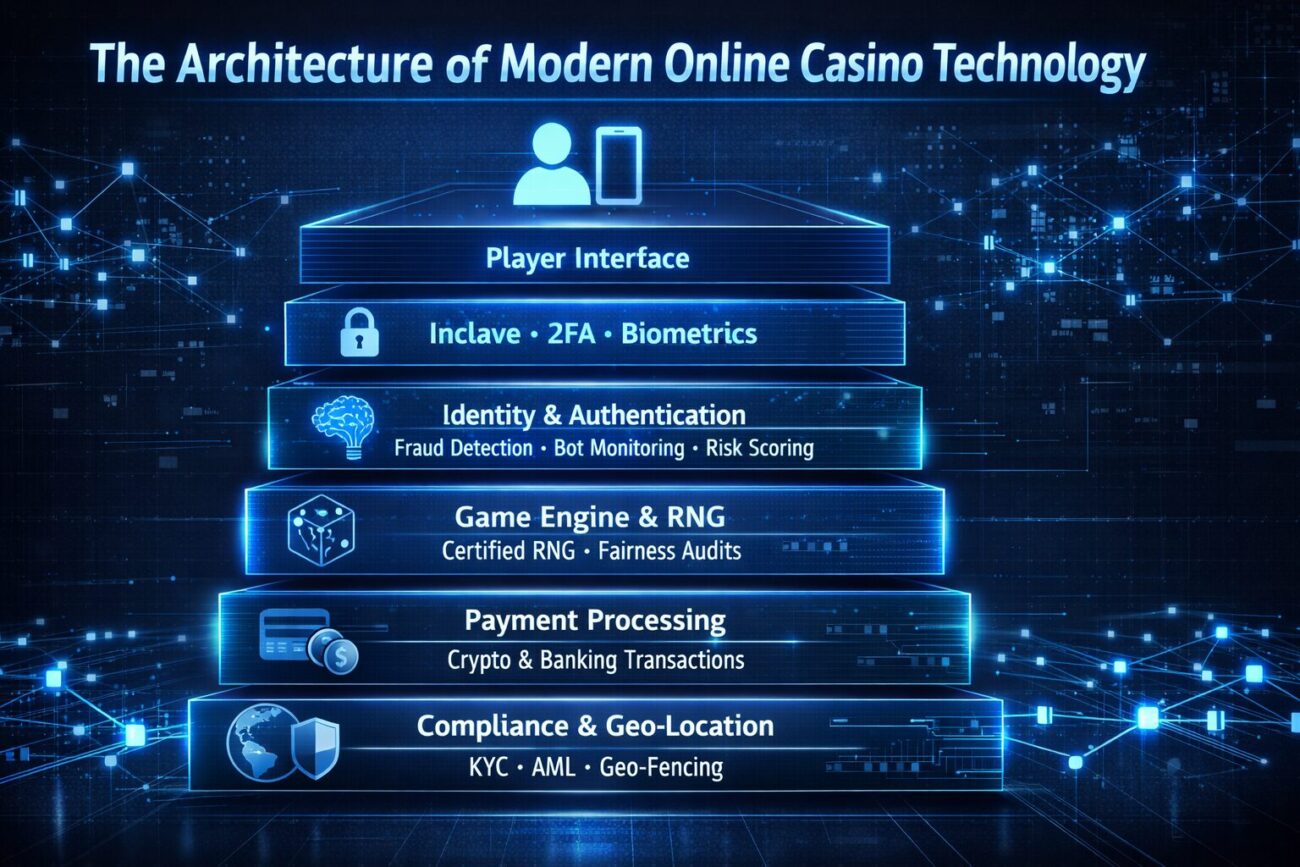
Online casinos today are not just websites with games. They are complex digital platforms built on layered security systems, real-time data processing, advanced identity management, and high-speed financial infrastructure. Behind every slot spin or blackjack hand sits a network of authentication tools, compliance engines, AI risk models, and payment processors working silently in the background.
Modern gambling platforms operate more like fintech companies than traditional entertainment brands. They must verify identities, prevent fraud, monitor transactions, detect bots, comply with international regulations, and deliver instant gameplay across desktop and mobile devices. That requires tightly integrated systems spanning authentication frameworks, machine learning models, geo-location controls, encrypted payment gateways, and certified game engines.
At GamblersPro.com, the focus is not only on reviewing casino brands but also on understanding the infrastructure that powers them. The technology stack behind a reputable online casino determines how secure your account is, how quickly you get paid, how fairly games operate, and how effectively suspicious activity is stopped. The better the technology, the safer and smoother the experience.
We break down the core systems that power modern online casinos, from login identity platforms and AI fraud detection to VPN monitoring, blockchain verification, and next-generation game development tools. Understanding this architecture gives players a clearer picture of what separates serious, secure platforms from weaker operators.
Identity & Authentication Systems
Every secure online casino begins with identity. Before a player can deposit, withdraw, or place a bet, the platform must verify who they are and ensure the account cannot be easily compromised. Modern casinos use layered authentication systems that go far beyond a simple username and password.
One major development in this space is Single Sign-On technology, which allows users to access multiple brands using one secure identity. In the gambling sector, identity platforms such as Inclave passwordless login systems that reduce credential theft while improving fraud monitoring across partner casinos. Instead of managing multiple passwords, players authenticate through a central identity layer, which also allows operators to track suspicious behaviour more effectively.
Behind the scenes, casinos often integrate frameworks such as OAuth for secure authorization and tools like Google Authenticator for two-factor authentication. These systems generate time-sensitive verification codes that add an extra security barrier if login credentials are compromised. Many platforms also deploy device fingerprinting technology, analysing browser configurations, operating systems, and hardware identifiers to detect unfamiliar login attempts.
Some operators are now experimenting with biometric authentication, including facial recognition and fingerprint login on mobile devices. The goal is clear: reduce friction for legitimate players while making account takeover attacks significantly more difficult. As identity technology continues to evolve, authentication is becoming one of the most critical foundations of online casino security.
KYC & Regulatory Compliance Technology
Once a player account is created, the next layer of technology focuses on compliance. Online casinos operate in tightly regulated environments where identity verification, anti-money laundering controls, and regional licensing rules must be enforced in real time. This is where automated Know Your Customer systems, commonly known as KYC, come into play.
Modern KYC technology allows casinos to verify government-issued documents, match selfies to ID photos using facial recognition, and validate addresses through secure databases. These systems are often integrated directly into onboarding flows, allowing verification to occur within minutes rather than days. The objective is twofold: prevent underage gambling and stop identity fraud before it can impact the platform.
Anti-money laundering monitoring is equally critical. Regulatory frameworks influenced by bodies such as the Financial Action Task Force require gambling operators to track unusual transaction patterns, flag high-risk accounts, and report suspicious activity. Licensed operators under regulators like the UK Gambling Commission or the Malta Gaming Authority must maintain robust transaction monitoring systems that can analyse deposit velocity, withdrawal behaviour, and source-of-funds indicators.
Geo-location technology is another essential component. Casinos use IP intelligence, GPS verification on mobile devices, and network analysis to ensure players are physically located in permitted jurisdictions. This prevents regulatory breaches and ensures operators remain compliant with licensing agreements. In modern online gambling, compliance is not manual paperwork. It is an automated, technology-driven enforcement layer that operates continuously in the background.
AI & Machine Learning in Fraud Detection
Artificial intelligence now sits at the core of modern online casino security. With thousands of transactions, logins, and gameplay actions occurring every minute, manual monitoring is impossible. Instead, operators rely on machine learning models that analyse behaviour in real time, flagging anomalies long before human teams would notice them.
Fraud detection systems examine dozens of behavioural signals simultaneously. These include login frequency, device switching patterns, deposit and withdrawal velocity, betting consistency, and bonus usage patterns. If a player suddenly changes wagering behaviour or logs in from multiple regions within a short time frame, risk engines can automatically trigger enhanced verification checks or temporary account restrictions. This layered approach protects both players and operators.
Multi-account detection is another key application of AI. Casinos look for shared device fingerprints, repeated IP patterns, payment method overlaps, and synchronised gameplay activity to identify bonus abuse rings. Machine learning models continuously refine themselves as new fraud tactics emerge, allowing detection systems to adapt rather than rely on static rule sets.
Game providers also integrate analytics into their platforms. Companies such as Evolution and Pragmatic Play operate at scale across dozens of operators, meaning they process enormous volumes of gameplay data. This data helps identify irregular betting behaviour, potential collusion patterns, and technical vulnerabilities. AI in online gambling is not just about personalization. It is primarily a defensive system designed to preserve fairness and platform integrity.
AI vs Poker Bots: The Ongoing Arms Race
Online poker presents one of the most complex security challenges in digital gambling. Unlike slot games or roulette, poker pits players against each other rather than the house. That creates incentives for sophisticated automation tools known as poker bots, which are designed to analyse odds and execute mathematically optimal decisions at scale. Detecting and eliminating these bots has become an ongoing technological arms race.
Modern poker security teams use machine learning to analyse behavioural fingerprints rather than just outcomes. AI systems track reaction times, betting intervals, mouse movement patterns, multi-table efficiency, and long-term statistical deviations from human norms. Bots often display consistent timing precision and decision patterns that differ subtly from natural human variance. Over thousands of hands, those micro-patterns become detectable signals.
Advanced detection systems also cluster accounts to identify coordinated bot networks. If multiple accounts share similar strategic profiles, synchronized activity windows, or identical bet-sizing patterns across tables, algorithms can flag them for deeper review. Operators then combine automated scoring with human security audits to confirm violations before taking action.
The sophistication of both sides continues to evolve. As bot developers incorporate more randomness and machine learning into their scripts, casino operators refine detection models with larger datasets and stronger anomaly detection tools. This constant cycle of adaptation underscores how online gambling platforms increasingly function like cybersecurity operations, protecting ecosystem integrity through continuous data analysis.
VPN Detection & Geo-Fencing Technology
Online casinos operate under strict regional licensing rules, which means access must often be restricted based on a player’s physical location. To enforce this, operators deploy layered geo-fencing systems that combine IP intelligence, device analysis, and network monitoring. The goal is to verify where a player is connecting from without disrupting legitimate gameplay.
At the most basic level, casinos analyse IP addresses using commercial intelligence databases. Services provided by companies such as MaxMind help determine whether an IP address originates from a residential network, a data centre, or a known proxy provider. Suspicious IP ranges commonly associated with VPNs or hosting services may trigger additional checks or account restrictions.
However, IP checks alone are no longer sufficient. Many platforms now integrate advanced browser fingerprinting techniques that analyse device configuration, screen resolution, installed fonts, time zone settings, and network characteristics. Infrastructure providers such as Cloudflare offer layered security services that can assist in detecting proxy usage and unusual traffic patterns. DNS leak detection and WebRTC analysis are also used to uncover masked connections.
For regulated markets, geo-location verification may extend beyond IP analysis. Some jurisdictions require GPS confirmation on mobile devices or Wi-Fi triangulation to ensure compliance with local laws. The broader objective is not simply to block VPN users, but to maintain licensing integrity and prevent cross-border regulatory violations. Geo-fencing technology has therefore become a critical compliance layer within the modern online casino architecture.
Game Engines, RNG & Fairness Certification
At the heart of every online slot spin or digital roulette outcome lies a Random Number Generator, commonly known as an RNG. This software algorithm continuously produces sequences of numbers at high speed, even when no one is actively playing. The moment a player clicks spin or deal, the system captures the most recent value generated and translates it into a game outcome. This ensures results are not predetermined and cannot be manipulated in real time.
Major software studios such as NetEnt and Microgaming build their games around certified RNG frameworks. These frameworks are designed to meet strict mathematical and regulatory standards, ensuring statistical randomness over millions of simulated rounds. Each game also operates with a predefined Return to Player percentage, or RTP, which reflects the theoretical long-term payout ratio under normal conditions.
Independent testing agencies play a crucial role in validating fairness. Organisations like eCOGRA audit software providers to confirm that RNG outputs match declared RTP values and that no hidden biases exist within the system. Certification seals from recognised testing bodies signal that the game mechanics have been independently reviewed and verified.
In addition to traditional RNG systems, some crypto-focused platforms implement provably fair technology. These systems allow players to verify game outcomes using cryptographic hashing techniques, increasing transparency by enabling independent validation. Whether through certified RNG audits or blockchain-based verification, fairness technology forms the backbone of trust in modern online casinos.
AI-Generated Games & Personalisation Engines
Artificial intelligence is not only being used to defend online casinos. It is increasingly being used to build and personalise them. Game development cycles that once took months can now be accelerated with AI-assisted design tools that generate themes, artwork concepts, soundscapes, and even gameplay mechanics based on structured prompts.
Some operators have experimented with interactive creation tools that allow users to imagine custom slot concepts and see them brought to life within minutes. For example, Stake has explored AI-driven tools such as SlotGPT, which demonstrate how generative systems could influence future game production. While these tools are still evolving, they illustrate how quickly content creation pipelines are changing in digital gambling.
Personalisation engines represent another major shift. Machine learning models analyse player behaviour to tailor homepage layouts, recommend specific games, adjust promotional offers, and optimise bonus timing. Instead of showing every user the same interface, casinos increasingly deploy adaptive systems that prioritise games and incentives based on past activity, session duration, and betting preferences.
This raises important questions about responsible gambling and ethical AI usage. Personalisation can improve user experience, but it must operate within regulatory boundaries that prevent harmful behavioural targeting. As artificial intelligence becomes more embedded in game creation and player engagement systems, the balance between innovation, entertainment, and responsible design will remain a central challenge for the industry.
Blockchain, Crypto Payments & Provably Fair Infrastructure
Cryptocurrency has introduced a parallel infrastructure layer within online gambling. Instead of relying solely on traditional banking rails, many operators now integrate blockchain-based payment systems that enable faster deposits, lower fees, and greater transaction transparency. This shift has expanded the global reach of online casinos while also introducing new technical considerations.
Platforms that support digital assets often process payments using networks such as Bitcoin and Ethereum. Transactions are broadcast to decentralised networks, verified by nodes, and recorded on public ledgers. Once confirmed, funds can be credited to casino accounts without the need for intermediary banks. This can reduce settlement times and minimise chargeback risk for operators.
Blockchain technology has also enabled the development of provably fair gaming systems. In these models, cryptographic hashes are generated before a game round begins and combined with player-generated inputs to determine outcomes. Because the hash values can be independently verified after the round is complete, players can confirm that results were not altered. This transparency mechanism is particularly popular among crypto-native gambling platforms.
Smart contract technology adds another dimension. Built primarily on programmable networks, smart contracts can automate payouts, escrow mechanisms, and promotional logic without requiring manual oversight. While not all casinos deploy on-chain gaming logic, the integration of blockchain infrastructure continues to influence how payments, fairness verification, and trust are engineered within modern online casinos.
Payment Processing & Fintech Integration
Beyond crypto infrastructure, modern online casinos rely heavily on traditional fintech systems to process deposits and withdrawals securely. Every transaction must pass through encrypted payment gateways that validate card details, screen for fraud indicators, and ensure compliance with regional banking standards. Speed, security, and reliability are critical, especially when large withdrawal volumes are involved.
Major global networks such as Visa and Mastercard facilitate card-based deposits, while digital wallets like Skrill provide faster settlement options with additional privacy layers. These integrations typically operate through secure APIs that connect casino platforms to banking infrastructure in real time.
Transaction monitoring tools run continuously in the background. Payment processors apply risk scoring models to detect unusual activity such as repeated failed deposits, rapid high-value withdrawals, or chargeback patterns. This reduces financial exposure for operators and protects players from unauthorised transactions. Many systems also include automated withdrawal approval thresholds, enabling smaller payouts to be processed instantly while flagging larger amounts for review.
As competition increases, speed has become a differentiator. Instant withdrawals, real-time balance updates, and automated currency conversion are now standard expectations. The strength of a casino’s payment infrastructure directly impacts user trust. Reliable fintech integration is therefore not just a convenience feature. It is a foundational component of modern online gambling architecture.
Data Security, Encryption & Infrastructure Resilience
Behind the login systems, AI monitoring tools, and payment gateways sits a critical foundation: infrastructure security. Online casinos process sensitive personal data, financial transactions, and identity documentation every second. Protecting that data requires multiple layers of encryption and resilient hosting architecture.
Secure platforms use SSL and TLS encryption protocols to ensure that data transmitted between a user’s device and the casino server cannot be intercepted or altered. When a website displays HTTPS in the browser bar, it indicates that communication is encrypted in transit. This protects login credentials, payment details, and uploaded verification documents from man-in-the-middle attacks.
Infrastructure resilience is equally important. Large operators often rely on distributed cloud environments such as Amazon Web Services to ensure uptime and scalability during peak traffic periods. Content delivery and security providers like Cloudflare help mitigate Distributed Denial of Service attacks, which attempt to overwhelm servers with malicious traffic. By filtering suspicious requests and distributing traffic across global networks, casinos reduce the risk of downtime.
Redundancy systems, automated backups, and failover mechanisms further strengthen operational stability. If one server cluster experiences issues, traffic can be rerouted instantly to secondary infrastructure. In a sector where uninterrupted access and financial security are essential, strong backend architecture is not optional. It is a defining characteristic of reputable operators.
Responsible Gambling Technology & Behavioural Safeguards
Technology in online gambling is not only designed to increase speed and security. It is also used to promote safer play. Modern platforms integrate responsible gambling tools directly into their architecture, allowing players to set personal boundaries and enabling operators to identify potential harm patterns before they escalate.
Most licensed casinos provide configurable controls such as deposit limits, loss limits, wagering caps, and session time reminders. These tools are built into account dashboards and can often be activated instantly without manual approval. Reality check notifications prompt players to review how long they have been active, while cooling-off periods and self-exclusion options allow temporary or permanent account suspension.
Beyond user-activated tools, many operators deploy behavioural monitoring models that analyse patterns associated with problematic gambling. AI systems can detect escalating bet sizes, shortened intervals between deposits, extended uninterrupted sessions, or repeated attempts to reverse withdrawals. When certain risk thresholds are reached, platforms may trigger automated warnings, enforce limits, or escalate the account for human review.
In regulated markets, responsible gambling frameworks are supported by organisations such as GambleAware and GamCare, which provide education and support services. By integrating behavioural analytics with player protection tools, modern online casinos aim to balance innovation with accountability. Responsible gambling technology is therefore not an afterthought. It is an embedded compliance and ethical layer within the broader digital infrastructure.
The Future of Casino Technology: AI Dealers, Biometric Identity & Fully Digital Platforms
Online casino technology continues to evolve at pace, and the next phase will likely be defined by deeper automation and smarter identity systems. Live casino providers are already experimenting with AI-assisted moderation tools, automated dealer analytics, and enhanced camera tracking to improve integrity in real time. Over time, fully AI-powered live dealers may emerge, blending natural language processing with computer vision to replicate human interaction at scale.
Biometric authentication is also expected to expand beyond optional login features. Facial recognition, fingerprint scanning, and behavioural biometrics such as typing rhythm analysis could become standard identity verification layers. These technologies would allow seamless logins while reducing account takeover risk, particularly when integrated with centralised identity platforms like Inclave and similar systems.
Virtual environments represent another frontier. With improvements in rendering engines and connectivity speeds, immersive digital casino floors may eventually replicate physical casino experiences within fully interactive online spaces. Whether through augmented reality interfaces or persistent virtual gaming environments, user engagement models are likely to shift toward more dynamic digital ecosystems.
What remains constant is the architectural principle underpinning modern platforms: security, compliance, fairness, and scalability must evolve alongside innovation. As AI systems become more autonomous and identity verification becomes more seamless, the line between fintech, cybersecurity, and entertainment will continue to blur. The casinos of the future will not simply be websites with games. They will be highly engineered digital platforms built on intelligent infrastructure.
Conclusion: The Invisible Architecture Behind Every Bet
Modern online casinos are no longer simple gaming websites. They are layered digital ecosystems built on identity management platforms, AI-driven fraud detection, certified random number generators, encrypted payment gateways, geo-location controls, and resilient cloud infrastructure. Every deposit, spin, and withdrawal passes through multiple automated systems designed to protect players, enforce compliance, and maintain fairness.
From authentication frameworks like Inclave to blockchain-based verification through networks such as Bitcoin and Ethereum, the technology stack behind reputable casinos continues to evolve. Artificial intelligence now shapes fraud prevention, game development, personalization engines, and responsible gambling safeguards, blurring the lines between fintech, cybersecurity, and entertainment.
Understanding this infrastructure helps separate serious, well-engineered operators from weaker platforms. At GamblersPro.com, analysing casino technology is just as important as reviewing bonuses or game libraries. The strength of the systems operating behind the scenes ultimately determines security, reliability, and long-term trust. In modern online gambling, the most important technology is often the part players never see.