
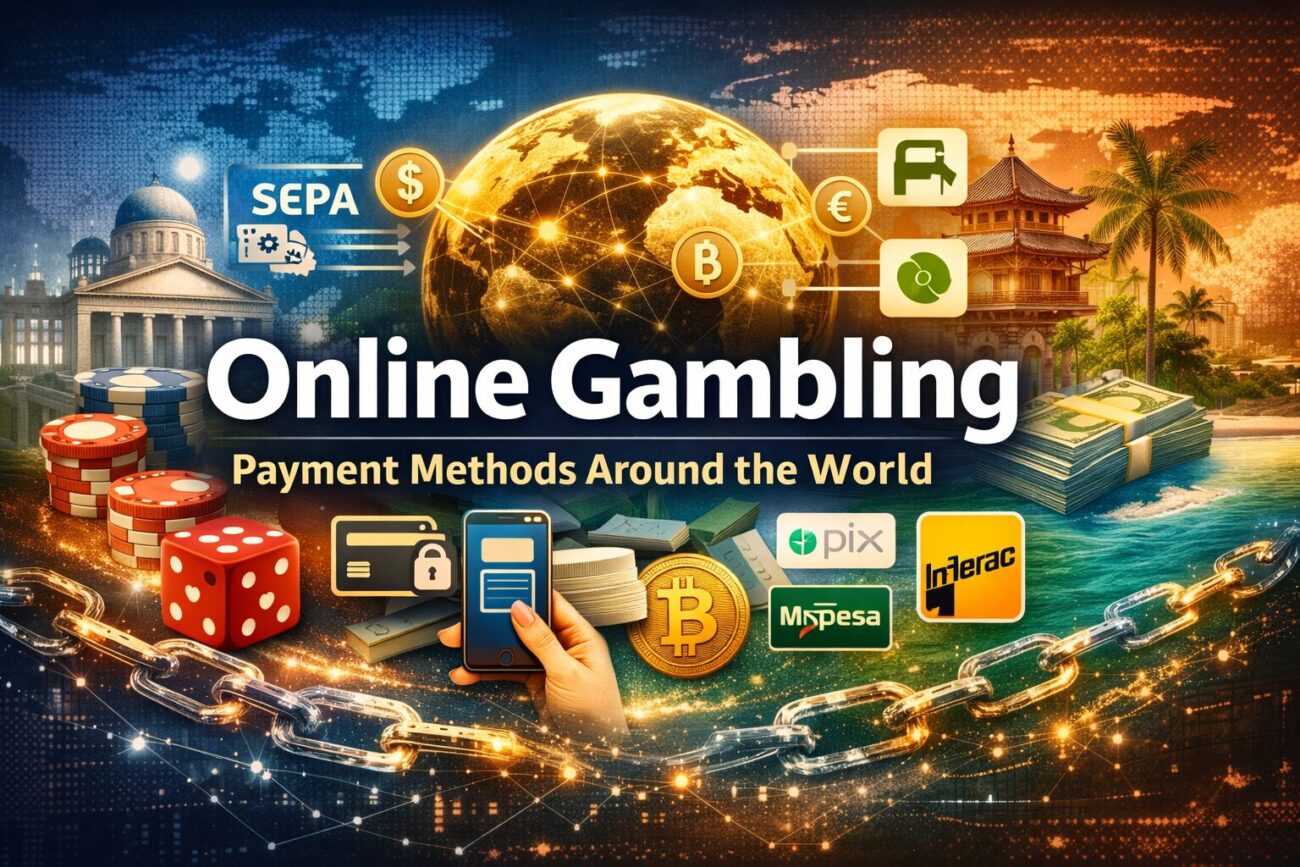
Online gambling depends on more than licensing and regulation. It relies on financial infrastructure. The payment methods available to players in any given region are shaped by banking systems, legal frameworks, technological adoption, and enforcement priorities. As a result, online gambling payment ecosystems differ significantly across the world.
In some jurisdictions, bank-based transfer systems dominate due to strong financial integration and open banking regulation. In others, mobile wallets or telecom-driven payment networks provide the primary access point. In markets where traditional banking channels are restricted or heavily monitored, cryptocurrencies or intermediary processors often fill the gap. These patterns are not accidental. They reflect deeper structural differences in how financial systems are organised and supervised.
This article examines how online gambling payment methods vary by region and why certain systems become dominant in specific markets. By analysing the legal, economic, and technological forces that shape payment adoption, it provides a structural overview of the financial architecture underpinning global online gambling.
Legal and Regulatory Drivers of Payment Infrastructure
Payment methods in online gambling are rarely determined by consumer preference alone. They are heavily shaped by regulatory frameworks, anti-money laundering controls, and financial supervision standards. In many jurisdictions, governments exert more influence over gambling markets through payment systems than through direct website enforcement.
Anti-money laundering obligations require licensed operators to verify customer identity, monitor transactions, and report suspicious activity. These requirements often dictate which financial channels are permitted. In the European Union, regulatory frameworks such as the Second Payment Services Directive (PSD2) and associated AML directives have encouraged the development of transparent, bank-integrated solutions. Open banking systems allow regulated operators to connect directly to verified financial institutions while maintaining compliance oversight.
In the United States, the Unlawful Internet Gambling Enforcement Act (UIGEA) illustrates how payment regulation can shape market behaviour. Rather than criminalising online gambling at the federal level, UIGEA focused on restricting financial institutions from processing unlawful gambling transactions. This approach led many banks to block card deposits to offshore gambling sites, indirectly influencing the payment methods available to American players.
Because online gambling operates across borders, payment systems become a primary enforcement lever. Governments may lack direct jurisdiction over foreign operators, but they can regulate domestic financial intermediaries. By imposing transaction monitoring requirements, blocking certain merchant codes, or limiting cross-border processing, regulators influence how easily players can fund accounts.
As a result, the dominant payment methods in any region reflect more than technological preference. They reveal how financial institutions are regulated, how compliance obligations are structured, and how governments choose to supervise gambling activity in practice.
Europe: Bank Transfers and Open Banking Dominance
Across much of Europe, online gambling payment systems are closely integrated with traditional banking infrastructure. High levels of financial inclusion, strong regulatory supervision, and the development of open banking frameworks have encouraged the widespread use of direct bank transfers and licensed intermediary services.
The Single Euro Payments Area (SEPA) enables cross-border euro transfers within participating countries under standardised rules, making bank-based deposits and withdrawals efficient and predictable. Building on this infrastructure, the Second Payment Services Directive (PSD2) introduced open banking requirements that allow regulated third-party providers to initiate payments directly from a customer’s bank account with explicit consent. This regulatory environment has supported the growth of services such as Trustly, which connects players to their bank accounts without requiring card details, and established e-wallets such as Skrill and Neteller, which operate under licensed financial frameworks. PayPal also maintains a presence in several regulated markets, subject to local compliance standards.
These systems are favoured because they align closely with European consumer protection and anti-money laundering priorities. Transactions are traceable, identity verification can be integrated into banking authentication processes, and operators can demonstrate regulatory compliance more easily than with loosely supervised alternatives. The result is a payment ecosystem where direct bank transfers and licensed intermediaries dominate over anonymous or cash-based methods.
Credit and debit cards remain available in many markets, but regulatory and responsible gambling policies in certain countries have introduced restrictions on card-based gambling transactions. Where such limitations exist, open banking solutions and instant bank transfer services often fill the gap.
Overall, Europe’s payment landscape reflects a mature financial system with strong regulatory oversight. Online gambling payment methods are shaped by harmonised banking infrastructure, consumer protection frameworks, and compliance-driven integration between operators and financial institutions.
North America: Cards, Intermediaries, and Cryptocurrency Under Federal Constraints
In North America, online gambling payment methods are shaped by a combination of federal oversight, state or provincial regulation, and institutional risk management by banks. Unlike Europe’s harmonised banking environment, the region operates within a more fragmented legal and financial framework, which directly influences how transactions are processed.
United States
In the United States, payment behaviour has been significantly influenced by the Unlawful Internet Gambling Enforcement Act (UIGEA). Rather than banning online gambling outright, UIGEA focused on prohibiting financial institutions from knowingly processing unlawful gambling transactions. As a result, many banks adopted conservative risk policies, frequently declining card payments associated with offshore gambling merchants.
Visa and Mastercard transactions are often subject to automated blocking based on merchant category codes. While deposits may succeed in regulated state markets, card declines remain common in cross-border contexts. Automated Clearing House (ACH) transfers are widely used within licensed state systems, providing bank-to-bank settlement under domestic oversight.
Cryptocurrency has also gained traction in segments of the U.S. market, particularly on offshore platforms. Assets such as Bitcoin, Ethereum, and stablecoins like USDT are used in part because they operate outside traditional banking rails. Their adoption reflects both technological familiarity and structural friction within card-based systems.
Canada
Canada presents a distinct payment ecosystem shaped by strong domestic banking integration and fintech mediation. Interac e-Transfer has become the dominant funding method at many online casinos serving Canadian players. Rather than transmitting card details, transactions are processed through secure bank messaging protocols, often facilitated by settlement intermediaries such as Gigadat. This structure allows funds to move directly between a player’s bank account and the operator without exposing sensitive financial credentials.
Deposits are typically completed within minutes, and withdrawals are commonly returned as Interac e-Transfer “Direct Requests” once approved. This model has achieved widespread adoption because it leverages existing Canadian banking infrastructure while maintaining high success rates across major institutions.
Traditional credit card deposits can encounter friction. Large Canadian banks, including RBC, TD, and Scotiabank, often decline gambling-coded Visa or Mastercard transactions as part of internal risk management policies. As a result, players frequently prioritise Interac e-Transfer or Visa Debit, which move settled funds and experience fewer blocks.
Infrastructure developments are further reshaping the landscape. Payments Canada’s Real-Time Rail (RTR) initiative is gradually enabling near-instant bank transfers that settle within seconds, including outside standard banking hours. As integration expands, this system is expected to reduce waiting periods for withdrawals and strengthen direct bank-based processing across the Canadian online gambling market.
Across North America, payment dominance reflects regulatory fragmentation and institutional caution. Card networks, intermediary settlement providers, and cryptocurrency coexist within a system shaped less by technological limitation than by legal structure and financial risk governance.
Asia: Mobile Wallet Ecosystems and State-Supervised Integration
Asia’s online gambling payment landscape reflects a combination of mobile-first financial adoption, state oversight, and varying levels of credit card penetration. In many parts of the region, digital wallets and super-app ecosystems play a more prominent role than traditional card networks.
In larger East Asian markets, platforms such as Alipay and WeChat Pay have transformed everyday commerce by embedding payments into multifunctional digital environments. While regulatory approaches to online gambling differ widely across the region, the broader financial infrastructure is heavily oriented toward wallet-based transactions rather than standalone card usage. This mobile-centric architecture influences how gambling operators structure deposits and withdrawals where permitted.
Southeast Asia illustrates how mobile finance can dominate in emerging digital economies. In the Philippines, the Philippine Amusement and Gaming Corporation (PAGCOR) plays a central role in licensing and supervising gambling activity. Payment integration within regulated environments often reflects domestic banking partnerships and authorised e-wallet systems. Services such as GCash and GrabPay are widely adopted for general commerce, and in jurisdictions where gambling is permitted, similar mobile channels may serve as the primary funding rails.
Credit card penetration in several Asian markets remains lower than in Western Europe or North America, which further reinforces reliance on wallet-based systems and direct bank transfers. At the same time, governments in many jurisdictions maintain strict capital controls or transaction monitoring frameworks. This means payment options are frequently aligned with national compliance priorities, and cross-border transfers may face greater scrutiny.
The result is a regionally diverse payment ecosystem unified by one common characteristic: digital wallets often sit at the centre of financial life. Where online gambling is regulated or tolerated, operators tend to integrate with these established mobile infrastructures rather than relying solely on international card networks. Payment dominance in Asia therefore reflects broader patterns of fintech adoption, regulatory supervision, and mobile-driven economic growth.
Oceania: Card Restrictions and Emerging Open Banking Models
In Oceania, online gambling payment systems reflect a combination of regulatory intervention and evolving financial technology infrastructure. Australia and New Zealand operate within mature banking environments, yet policy decisions have significantly influenced how gambling transactions are processed.
In Australia, legislative reforms have introduced restrictions on the use of credit cards for online wagering. Financial institutions are required to block credit-funded gambling transactions, aligning payment policy with responsible gambling objectives. As a result, debit cards, direct bank transfers, and digital wallet alternatives have become more prominent. Bank-based deposits remain widely used, but operators must integrate with domestic compliance frameworks and transaction monitoring systems.
New Zealand presents a slightly different landscape. While residents may access offshore online gambling platforms, domestic regulatory oversight remains structured around state-controlled models. Open banking initiatives are beginning to influence payment integration. Fintech services such as Akahu enable secure bank connectivity under emerging open banking frameworks, allowing authorised platforms to initiate transfers directly from customer accounts with user consent. At the same time, some traditional instant transfer providers, such as POLi, have faced operational and compliance challenges, contributing to a gradual shift toward more formally regulated payment solutions.
Across the Pacific Islands, regulatory development varies considerably. In some jurisdictions, financial infrastructure remains less centralised, and online gambling participation may rely on international card networks, e-wallets, or cryptocurrency. Limited domestic payment rails and smaller banking systems mean cross-border processors often play a greater role where activity occurs.
Oceania’s payment environment therefore reflects both regulatory tightening and technological transition. Credit restrictions, open banking experimentation, and the gradual phasing out of informal transfer intermediaries illustrate how payment dominance is shaped by responsible gambling policy, financial supervision standards, and evolving fintech infrastructure.
Africa: Telecom-Driven Mobile Money Infrastructure
In much of Africa, online gambling payment methods are shaped by a financial ecosystem that developed differently from traditional Western banking models. In several countries, mobile money services introduced by telecommunications providers became the primary channel for digital finance before widespread bank account adoption. As a result, mobile wallets often serve as the foundation for online transactions, including gambling where permitted.
Services such as M-Pesa in East Africa and Orange Money in parts of West and Central Africa illustrate how telecom-driven financial systems can achieve national scale. These platforms allow users to deposit, withdraw, and transfer funds using mobile devices without requiring conventional bank accounts. Agent networks support cash-in and cash-out functionality, bridging digital payments with cash-based economies.
Because traditional credit card penetration remains comparatively low in many African markets, mobile money solutions provide a practical and accessible alternative. For online gambling operators serving these regions, integration with telecom-linked wallets is often more viable than relying on international card networks. Transactions can be authenticated through mobile devices, and settlement occurs within established domestic payment loops.
Regulatory approaches vary across the continent, with some jurisdictions developing structured licensing systems while others maintain restrictive policies. In either case, financial supervision typically occurs through central banks and telecom regulators rather than through card issuers. Payment monitoring and compliance mechanisms are therefore closely tied to national mobile money infrastructures.
Africa’s online gambling payment landscape reflects a broader economic pattern: financial inclusion has advanced through mobile technology rather than through legacy banking expansion. Where online wagering activity exists, it is frequently layered onto these established telecom-based systems, demonstrating how payment dominance follows infrastructure availability rather than global uniformity.
Latin America: Instant Transfers and Cash-Linked Payment Bridges
Across Latin America, online gambling payment systems reflect a mix of cash-prevalent economies and rapidly modernising fintech infrastructure. While traditional banking access has expanded in recent years, many markets continue to operate with strong cash usage, which has influenced how digital payments are structured.
One of the most significant developments in the region has been the rise of instant bank transfer systems. In Brazil, the central bank introduced PIX as a real-time payment network that allows individuals and businesses to transfer funds instantly, twenty-four hours a day. Its rapid adoption has reshaped digital commerce and, in regulated gambling environments, provided a fast and traceable funding channel that aligns with compliance requirements.
In other parts of the region, hybrid systems bridge the gap between cash and online platforms. Services such as PagoEfectivo in Peru and OXXO in Mexico allow users to generate a payment reference online and complete the transaction in cash at authorised retail locations. This model accommodates consumers who may not have credit cards or prefer not to use bank transfers directly, while still enabling digital account funding.
Credit and debit cards are available in many countries, but transaction approval rates can vary depending on issuer policies and cross-border risk management. As regulatory frameworks for online gambling continue to evolve across the region, payment providers often adjust their integration models to align with new compliance standards and central bank oversight.
Latin America’s payment landscape demonstrates how innovation can emerge from structural constraints. Instant transfer networks, fintech platforms, and cash-linked systems coexist within an environment where financial inclusion is expanding but remains uneven. Online gambling operators adapt to this diversity by integrating multiple funding channels that reflect both regulatory supervision and consumer payment habits.
Middle East: Restrictive Banking Environments and Alternative Channels
In much of the Middle East, online gambling payment systems are shaped primarily by legal and religious constraints. In many jurisdictions, gambling is prohibited or heavily restricted under national law, and financial institutions operate within regulatory frameworks that reflect those policies. As a result, domestic banks typically do not facilitate gambling transactions, and merchant category codes associated with wagering are frequently blocked.
Because formal licensing systems are limited in many countries across the region, regulated domestic payment integration is uncommon. Financial oversight is often conservative, with strong compliance monitoring and transaction scrutiny. This reduces the availability of traditional card-based deposits and direct bank transfers for gambling purposes within domestic financial systems.
Where participation occurs through offshore platforms, alternative channels may be used. These can include international e-wallets, intermediary processors, or in some cases cryptocurrencies. Digital assets such as Bitcoin and stablecoins are sometimes utilised in environments where cross-border financial controls are strict, as they operate outside conventional banking rails. However, adoption patterns vary widely, and regulatory risk remains a significant factor.
The payment landscape in the Middle East therefore reflects broader governance priorities. Financial institutions function as enforcement mechanisms, aligning transaction monitoring with national policy objectives. Where gambling is restricted, payment friction becomes part of the regulatory structure itself. Unlike regions with structured licensing and integrated banking solutions, payment systems here are defined more by constraint than by commercial optimisation.
Cryptocurrency as a Cross-Border Settlement Layer
Across multiple regions, cryptocurrencies have emerged as a parallel payment layer within online gambling markets. Unlike bank transfers or card networks, digital assets operate on decentralised blockchain infrastructure, allowing transactions to move across borders without direct reliance on domestic financial institutions.
Bitcoin was the first cryptocurrency widely adopted by online gambling platforms, particularly those operating internationally. Its appeal lies in its ability to facilitate peer-to-peer transfers without intermediary banks. Ethereum expanded this ecosystem by enabling token-based assets and smart contract integration, while stablecoins such as USDT reduced exposure to price volatility by pegging value to major fiat currencies.
Cryptocurrency adoption tends to increase in markets where traditional banking channels are restricted, blocked, or inefficient. In jurisdictions influenced by payment regulations such as the Unlawful Internet Gambling Enforcement Act in the United States, or in regions with capital controls and cross-border limitations, digital assets provide an alternative settlement path. They can bypass merchant category restrictions and reduce the likelihood of transaction declines by domestic banks. See why crypto casinos took hold faster in the USA for a deeper explanation.
However, cryptocurrency does not operate outside regulatory influence entirely. Licensed operators in many jurisdictions must still comply with anti-money laundering standards and perform identity verification, even when accepting digital assets. Regulatory authorities increasingly monitor blockchain transactions and apply compliance expectations to platforms integrating crypto payments.
The role of cryptocurrency in online gambling therefore reflects both technological innovation and structural friction within traditional financial systems. It serves as a cross-border settlement layer that expands access, particularly in fragmented or restrictive banking environments, while gradually becoming incorporated into formal compliance frameworks in regulated markets.
Enforcement Through Payment Systems
In online gambling, payment infrastructure often functions as the primary enforcement mechanism. While websites can be hosted offshore and accessed across borders, financial institutions operate within defined legal jurisdictions. Governments may have limited ability to shut down foreign platforms directly, but they can regulate domestic banks, card networks, and payment processors.
Merchant category codes allow banks and card issuers to identify gambling-related transactions. Financial institutions can decline these payments automatically based on internal risk policies or regulatory guidance. This approach has been used in multiple jurisdictions to restrict access to unlicensed operators without criminalising individual players. By targeting the financial layer, regulators influence market behaviour indirectly but effectively.
Anti-money laundering obligations further reinforce this structure. Licensed operators must verify customer identity, monitor transaction patterns, and report suspicious activity to relevant authorities. Payment providers are similarly required to maintain compliance controls. These reporting systems create a network of oversight that extends beyond gambling regulators to central banks and financial intelligence units.
Payment blocking, transaction monitoring, and settlement restrictions therefore shape the practical accessibility of online gambling. Even where legal frameworks permit wagering, operators must align with domestic financial compliance standards. Where gambling is restricted, enforcement frequently occurs through banking channels rather than through direct website intervention.
The dominance of particular payment methods in any region is thus closely tied to how enforcement authority is exercised. Online gambling is not governed solely by gaming law. It operates within broader financial supervision systems that determine how funds move, how transactions are recorded, and how regulatory oversight is applied in practice.
Conclusion
Online gambling payment methods are not distributed randomly across the world. They reflect the structure of domestic banking systems, regulatory priorities, technological adoption patterns, and cultural attitudes toward financial risk and digital commerce. Whether bank transfers dominate in Europe, Interac e-Transfer shapes the Canadian market, mobile wallets lead in parts of Asia and Africa, or instant transfer networks expand in Latin America, payment preferences mirror underlying financial architecture.
Legal frameworks play a decisive role. Regulations such as the Unlawful Internet Gambling Enforcement Act in the United States and PSD2 in Europe have influenced how operators integrate with banks and intermediaries. Anti-money laundering requirements and transaction monitoring standards further shape which systems are viable in regulated markets. Where gambling is restricted, financial institutions often become the primary enforcement layer.
At the same time, technological innovation continues to reshape the landscape. Real-time settlement rails, open banking integration, mobile-first ecosystems, and cryptocurrency networks introduce new settlement pathways that adapt to regional constraints. These developments demonstrate that online gambling is as much a financial infrastructure system as it is an entertainment industry.
Understanding global payment patterns therefore requires examining the broader economic and regulatory context in which they operate. The methods players use to deposit and withdraw funds provide insight into how financial systems function, how governments exercise oversight, and how online gambling markets evolve across different regions of the world.