
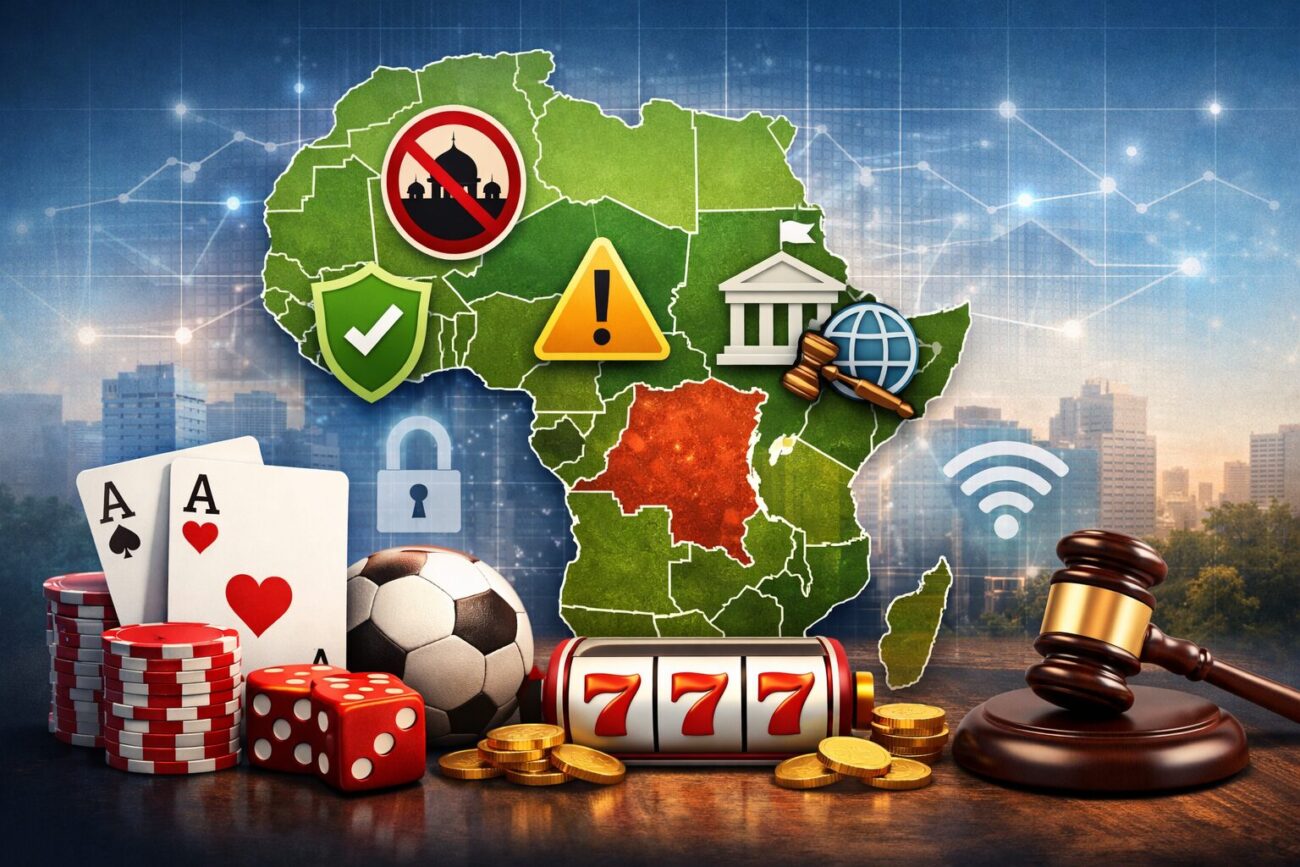
Africa does not have one online gambling system.
Some countries license sports betting but have much less clear rules for online casinos. Others regulate casinos and betting through established gambling boards. Parts of North Africa restrict gambling heavily, while several countries still rely on laws written before modern online casinos became common.
The biggest pattern is simple: sports betting regulation is often ahead of online casino regulation.
Football betting, mobile money, and licensed bookmakers have grown quickly across much of Sub-Saharan Africa. Online casino games often arrived through the same platforms, but the laws did not always develop at the same speed.
This guide compares 13 African markets and breaks them into five broad models. For individual casino markets and available operators, see our guide to online gambling across Africa.
What the Africa Data Shows
The 13 countries used in this comparison fall into five main groups.
3 of 13 are betting-first markets where sports wagering is clearly licensed but online casino rules are less distinct.
2 of 13 have more developed gambling systems covering casinos and betting, although online casino play can still face restrictions.
3 of 13 use prohibition or heavy religious restrictions.
3 of 13 have older or incomplete laws that leave online gambling in a grey area.
2 of 13 use tightly controlled or state-led gambling systems.
The result is a continent where legal access can differ sharply between sports betting, land casinos, and online casino games.
Five Main Gambling Models Across Africa
| Model | Countries | How It Works |
|---|---|---|
| Betting-First Regulation | Kenya, Nigeria, Ghana | Sports betting is clearly licensed, while online casino games sit inside broader or less specific rules. |
| Broader Gambling Regulation | South Africa, Mauritius | Established gambling authorities regulate casinos and betting, but online casino access can still be limited. |
| Prohibition or Heavy Restriction | Algeria, Morocco, Egypt | Gambling is banned or heavily restricted, while some offshore access remains possible. |
| Grey or Older Legal Frameworks | Uganda, Tanzania, Zimbabwe | Older laws do not always deal clearly with modern online casino products. |
| State-Controlled Systems | Ethiopia, Tunisia | The state keeps tight control over gambling and limits private market entry. |
1. Sports Betting Is Often Regulated First
Countries: Kenya, Nigeria, Ghana
This is one of the clearest patterns in African gambling.
Sports betting has grown quickly because it fits three things already common across many markets:
- strong football culture;
- mobile-first internet use;
- mobile money and digital payments.
Governments can license bookmakers, collect tax, and monitor payments without first creating a completely separate online casino system.
Kenya
Kenya has a well-established betting market regulated by the Betting Control and Licensing Board.
Sports betting is closely connected to mobile money, especially M-Pesa.
Online casino games are also available, but the legal system has historically focused much more clearly on betting.
Nigeria
Nigeria has one of Africa’s largest betting markets.
Its system is more complicated because gambling authority can overlap between federal and state bodies.
Our guide to online casino laws in Nigeria explains that split in more detail.
Sports betting is widely licensed.
Online casino games also exist, but they are not always separated as clearly from the wider betting market.
Ghana
Ghana also licenses betting operators through a national gambling system.
Again, sports betting is the clearest part of the market.
Online casino games often sit under the broader gambling licence rather than having a completely separate legal system.
The Betting-First Pattern
These markets share several features:
- bookmakers are licensed and taxed;
- mobile payments are central;
- sports betting has clear legal recognition;
- online casino rules are often less specific;
- enforcement focuses heavily on operators, licences, and tax.
That makes sports betting the entry point for regulated online gambling in many African countries.
2. A Country Can Regulate Casinos but Still Restrict Online Play
Countries: South Africa, Mauritius
South Africa shows why gambling law cannot be reduced to “legal” or “illegal.”
The country has a mature gambling system.
Land casinos are legal.
Sports betting is legal.
But full online casino gaming remains restricted.
Our guide to how South Africa legalised casinos but restricted online play explains that divide.
This produces an unusual result.
A player can legally visit a physical casino or place certain online bets, while the rules for interactive casino games remain much tighter.
Mauritius also has an established gambling authority, licensed casinos, and regulated betting.
Online gambling is more closely controlled than an open international casino market.
What This Model Shows
Having a strong gambling regulator does not automatically mean every gambling product is legal.
Governments can treat:
- sports betting;
- land casinos;
- lotteries;
- online casinos;
as separate products.
That is one of the most important points when comparing African gambling laws.
3. North Africa Includes Some of the Most Restrictive Markets
Countries: Algeria, Morocco, Egypt
Parts of North Africa use much stricter gambling rules.
Religion plays a larger role in public policy, and broad commercial gambling markets are less common.
Algeria
Algeria prohibits most gambling.
There is no broad domestic licensing system for online casinos or commercial sports betting.
Players may still be able to reach offshore websites, but that is different from having a locally regulated market.
Morocco
Morocco is more mixed.
Land casinos operate under government supervision, particularly around tourism.
Online gambling is much more tightly controlled and does not operate through a broad competitive online casino licensing market.
Egypt
Egypt also restricts gambling heavily.
Some tourist-focused casino activity exists, but there is no open domestic online casino market for general participation.
Restriction Does Not Always Mean No Access
A gambling website may still be technically reachable even when domestic law does not license it.
That creates a difference between:
legal permission
and
technical access.
Governments can also restrict gambling through banks, payment processors, or telecom systems instead of trying to block every website individually.
4. Older Laws Create Grey Markets
Countries: Uganda, Tanzania, Zimbabwe
Some African gambling laws were written before mobile betting and online casinos became large industries.
That creates a different problem.
The country may regulate betting businesses, but the law may not clearly describe every digital casino product those companies now offer.
Uganda
Uganda has licensed betting and collected gambling taxes.
Digital products have developed quickly around that market.
Online casino games do not always fit neatly into the categories created by older legislation.
Tanzania
Tanzania also regulates gambling through a gaming board.
Mobile betting expanded quickly, while some online casino-style products entered through existing betting structures rather than a completely separate digital casino law.
Zimbabwe
Zimbabwe shows another issue.
A country can have gambling law on the books but limited resources for monitoring every offshore website available to residents.
Regulators naturally focus more heavily on visible domestic businesses.
What Creates the Grey Area?
These markets often share four features:
- gambling laws were written before modern digital gambling;
- sports betting is easier to classify than online casino games;
- offshore websites remain available;
- enforcement focuses on local operators and tax collection.
The result is not necessarily complete absence of regulation.
It is a gap between the law that exists and the products now available online.
5. Some Governments Keep Gambling Under Tight State Control
Countries: Ethiopia, Tunisia
Not every country chooses between an open licensed market and outright prohibition.
Some use a third approach.
They allow limited gambling but keep very strong control over who can operate.
Ethiopia uses a tightly supervised gambling system rather than a broad competitive online casino market.
Tunisia also allows some gambling activity, especially around tourism, while keeping online expansion limited.
How State-Controlled Markets Work
These systems often have:
- limited numbers of operators;
- strong government oversight;
- restricted online expansion;
- close control over financial activity.
This is different from prohibition.
The government does not necessarily ban gambling.
It controls where, how, and by whom it can be offered.
Africa’s Biggest Regulatory Divide Is Between Betting and Casinos
The most useful way to compare these markets is not simply to ask whether gambling is legal.
The better question is:
Which type of gambling is regulated?
A country may have:
- licensed sports betting;
- legal land casinos;
- no separate online casino licence;
- offshore online casinos that remain accessible.
All four can exist at the same time.
That is why the legal position can look confusing if every gambling product is treated as one category.
Mobile Money Changed African Gambling
Payments are a major reason sports betting expanded so quickly.
Many African markets moved directly into mobile payments without building the same card-heavy banking systems used in Europe and North America.
Services such as M-Pesa made small digital payments easy.
That is a natural fit for sports betting.
A player can:
- fund an account from a phone;
- place a small bet;
- receive winnings back through the same payment system.
This helped online betting grow even where traditional banking access was lower.
It also gave governments another way to monitor gambling payments.
Crypto Creates Another Payment Layer
Crypto can reduce dependence on local banks and mobile payment systems.
That becomes especially important in countries where:
- banks restrict gambling payments;
- international cards do not work well;
- offshore casinos dominate the online market.
Our analysis of crypto gambling in Africa looks at how digital assets fit into those gaps.
Crypto does not change a country’s gambling law.
It changes how easily money can move around the banking restrictions used to enforce that law.
How African Gambling Rules Are Enforced
Enforcement does not work the same way everywhere.
Different countries can focus on different parts of the market.
| Enforcement Method | What It Targets | Where It Matters Most |
|---|---|---|
| Licensing | Local gambling companies | Regulated betting markets |
| Tax collection | Licensed operators and betting revenue | Betting-first markets |
| Payment restrictions | Deposits and withdrawals | Restricted markets |
| Telecom controls | Website and network access | Markets using stronger digital restrictions |
| State concessions | Who can enter the market | State-controlled systems |
This explains why two countries can have similar gambling laws but very different markets in practice.
The law is only one part.
The ability to control operators and payments matters too.
Why Offshore Casinos Remain Important
Offshore casinos appear across several of the five models.
They are especially important where:
- there is no domestic online casino licence;
- local casino choices are limited;
- laws focus mainly on sports betting;
- enforcement focuses on domestic operators.
That does not make those casinos locally licensed.
It means offshore supply can exist alongside domestic regulation.
This distinction matters across much of Africa.
Payment Systems Often Decide What Is Practical
A player may technically be able to visit an offshore casino.
The harder question is whether they can deposit and withdraw.
That depends on the local payment system.
Mobile money dominates in some markets.
Cards and bank transfers matter more elsewhere.
Crypto adds another cross-border option.
Our guide to online gambling payment methods worldwide explains how these systems differ.
The payment layer can therefore make a gambling restriction much stronger or much weaker in practice.
What Is Changing Across Africa?
The continent is not moving toward one common gambling law.
But several pressures are pushing governments to deal more directly with online gambling.
1. Mobile Betting Keeps Growing
As more financial activity moves onto phones, gambling becomes easier to fund and easier for governments to track.
2. Casino Products Are Catching Up With Sports Betting
Sportsbooks increasingly offer slots and other casino games alongside betting.
That forces regulators to decide whether older betting licences also cover those products.
3. Crypto Makes Payment Controls Harder
Crypto gives offshore platforms another way to accept cross-border payments.
That can weaken gambling restrictions based mainly on local banks.
4. Governments Want Tax Revenue
Where gambling is already happening, governments have an incentive to bring operators into a licensed tax system rather than leave the entire market offshore.
Conclusion
Africa does not have one online gambling model.
The 13 markets in this comparison fall into five broad groups.
Kenya, Nigeria, and Ghana show the betting-first model, where sports wagering is clearly regulated but online casino rules are less distinct.
South Africa and Mauritius have stronger gambling institutions, while still placing limits on some forms of online play.
Algeria, Morocco, and Egypt use much more restrictive systems.
Uganda, Tanzania, and Zimbabwe show how older laws can leave digital gambling in grey areas.
Ethiopia and Tunisia keep stronger state control over market access.
The biggest lesson is simple:
the key question in Africa is often not whether gambling is legal, but which form of gambling the law actually regulates.
Sports betting, land casinos, and online casino games can have completely different legal positions inside the same country.
Mobile money, offshore websites, and crypto add another layer.
That is why African gambling markets need to be looked at country by country and product by product, rather than being reduced to a single legal label.
Gavin analyzes online gambling regulation, licensing systems, and market structure across international jurisdictions. With over a decade of experience covering the iGaming sector, his research focuses on how national gambling laws, regulatory authorities, and compliance frameworks shape legal online casino markets. This guide was prepared using primary regulatory sources and official publications from European gambling authorities.