
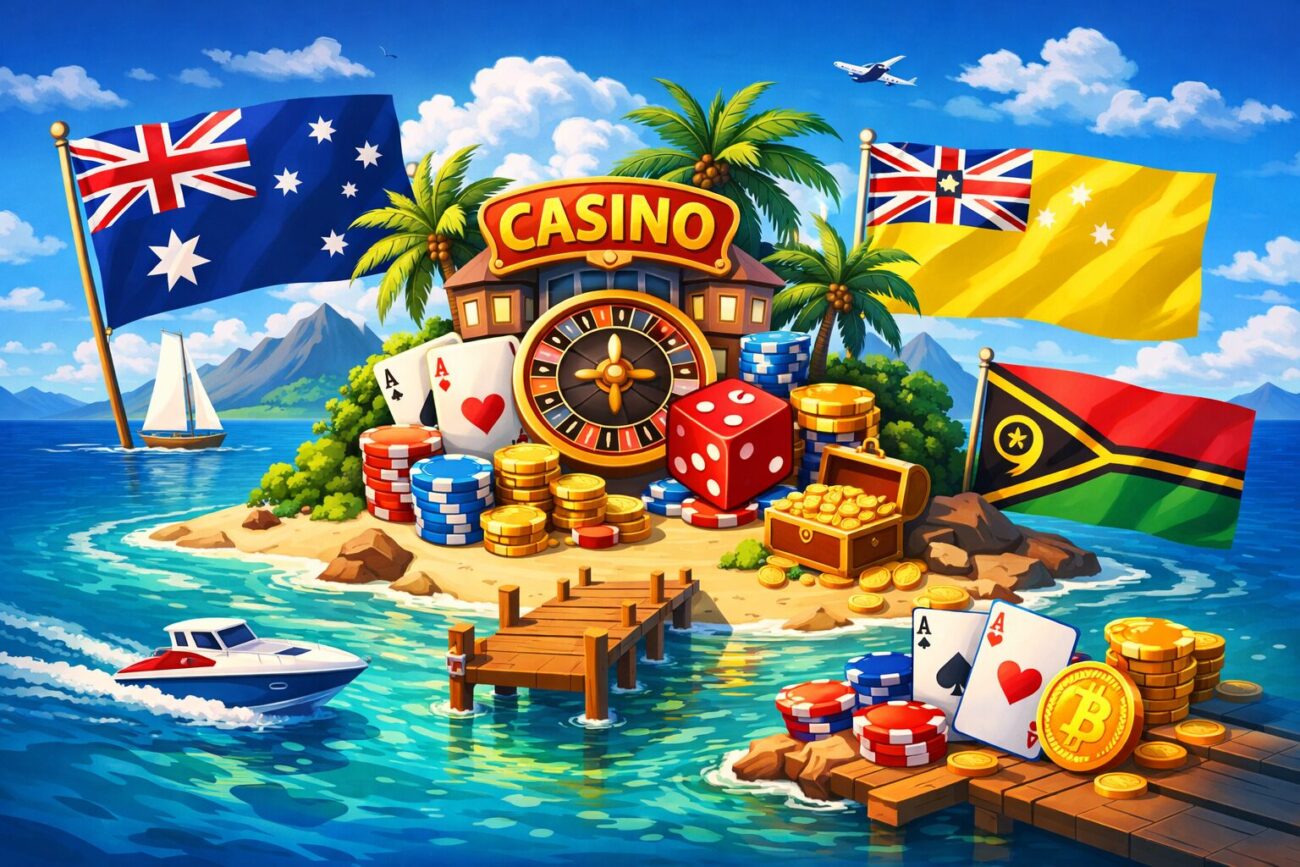
In much of Oceania, online casino access has developed through cross-border service models rather than through domestic licensing systems. Several countries in the region do not provide for locally licensed online casinos, which has shaped an environment where players who engage with online casino platforms often do so through operators based in other jurisdictions. As a result, offshore services have become a structural feature of how online casino activity functions across the region.
This pattern is closely tied to how national laws were designed. In Australia, federal legislation restricts the provision of certain online gambling services domestically, while in New Zealand, online casino-style gambling is not established through a local licensing framework. These legal settings did not eliminate online casino demand but instead influenced where and how services are supplied, with cross-border operators filling much of the space.
Understanding the role of offshore casinos in Oceania therefore requires looking at regulatory structure, digital market mechanics, and payment infrastructure together. Offshore platforms are not simply an alternative within the region’s gambling landscape; they are a product of how online gambling policy, jurisdictional limits, and internet-based services intersect across Oceania.
TL;DR: In Oceania, offshore casinos are not a niche segment but a structural feature of the online casino market. Countries such as Australia and New Zealand do not operate domestic online casino licensing systems, which has shaped a landscape where cross-border operators play a central role. Smaller Pacific nations show similar patterns due to market size and regulatory capacity, with past experiments in places like Niue and Vanuatu not developing into long-term licensing hubs. Payment infrastructure, jurisdictional limits, and digital service models together explain why offshore provision forms the backbone of online casino access across much of Oceania.
What “Offshore” Means in This Context
In online gambling, the term “offshore” generally refers to operators that are licensed and based in a jurisdiction different from the player’s country of residence. These platforms deliver services across borders through the internet rather than through a locally issued licence. The key distinction is therefore jurisdictional: the operator’s regulatory home sits outside the player’s national legal framework.
This does not automatically mean the operator is unlicensed or operating without oversight. Many offshore casinos hold licences from recognised gambling authorities in other parts of the world. However, their regulatory obligations, dispute resolution processes, and compliance standards are tied to the licensing jurisdiction rather than to the player’s home country. That separation shapes how consumer protections, enforcement actions, and oversight mechanisms apply in practice.
In Oceania, this structure becomes especially relevant because several countries do not operate domestic online casino licensing systems. As a result, the “offshore” label describes not a niche segment of the market, but the primary model through which online casino services are made available across much of the region.
How Australian Law Shaped This Outcome
In Australia, the structure of the online casino market is closely linked to federal law. The Interactive Gambling Act 2001 restricts the provision of certain interactive gambling services to people in Australia, including online casino-style games. As a result, a domestic licensing pathway for online casinos did not develop in the same way it has in some other regions.
Enforcement activity has focused on discouraging operators from offering prohibited services to Australian residents. This has included regulatory actions, public warnings, and measures aimed at limiting the targeting of Australian players by unlicensed providers. The legal design therefore shaped the market indirectly: rather than fostering a local online casino sector, it contributed to an environment where such services are supplied primarily from outside the country.
This does not eliminate online casino access, but it changes the structure of supply. Where domestic licensing is not available, online casino activity that occurs tends to be tied to cross-border platforms. In this sense, the offshore role in Australia is not simply a market choice but a consequence of how national law defined the scope of permitted online gambling services.
How New Zealand’s Framework Leads to a Similar Structure
A comparable pattern can be seen in New Zealand, where online casino-style gambling is not established through a domestic licensing system. The country’s gambling law framework focuses primarily on land-based sectors and specific authorised activities, leaving no locally licensed pathway for commercial online casino operators. This means that a domestic online casino industry did not develop in parallel with digital gambling growth.
In practice, players who choose to access online casino platforms often do so through operators based overseas. These services operate under foreign licences and outside New Zealand’s direct regulatory structure. The legal environment therefore influences market shape rather than eliminating access, resulting in a system where cross-border provision plays a central role.
Enforcement emphasis and policy style differ from country to country, but the structural outcome is similar: without a domestic online casino licensing regime, the market channel that remains most visible is offshore. As in Australia, the presence of offshore casinos reflects how legal frameworks defined the boundaries of permitted online gambling rather than a simple absence of regulation.
Why Smaller Pacific Nations Show Similar Patterns
Beyond Australia and New Zealand, several smaller Pacific nations display similar structural outcomes, though for different reasons. In many cases, domestic online casino licensing systems were never developed at scale, either because the local market is small or because regulatory attention has been directed toward other economic sectors. As a result, there is often no established pathway for locally based commercial online casino operators.
Historically, some jurisdictions experimented with positioning themselves as online gambling licensing hubs. Niue and Vanuatu, for example, were associated with short-lived efforts to issue online gambling-related licences during earlier phases of internet gaming growth. These initiatives did not develop into long-term, large-scale regulatory systems, and today they do not function as major centres for mainstream online casino licensing. Their experience illustrates how small jurisdictions have at times explored digital gambling as a policy option, but without creating enduring domestic market structures.
In the absence of substantial local licensing frameworks, online casino access in many Pacific states is shaped primarily by cross-border services. Offshore platforms therefore appear not as an exception but as a structural feature of how digital gambling operates in these environments, influenced by market size, administrative capacity, and the global nature of online services.
Payments as the Enabler of Offshore Access
The ability of offshore casinos to serve players across Oceania depends heavily on payment systems. Cross-border digital gambling requires financial channels that can operate between the player’s country and the operator’s jurisdiction. International card networks, digital wallets, and in some cases cryptocurrencies provide the infrastructure that allows transactions to move beyond domestic banking boundaries.
Where local online casino licensing systems are limited or absent, payment flows often become the practical bridge between players and offshore services. Deposits and withdrawals are processed through global payment rails rather than through nationally supervised gambling payment frameworks. This means that the structure of the financial system, including how banks and payment providers handle gambling transactions, plays a central role in determining how accessible offshore platforms are in practice.
Payment infrastructure therefore interacts directly with legal structure. Even when domestic law shapes who may offer services locally, cross-border payment capabilities can support the continued visibility of offshore operators. In Oceania’s online casino environment, financial systems are part of the underlying architecture that makes offshore access function as a regional market model.
Player Protection Differences in Offshore Environments
When online casino services are provided through offshore operators, player protection frameworks can differ from those found in domestically licensed systems. Safeguards such as self-exclusion schemes, advertising rules, and dispute resolution mechanisms are typically tied to the operator’s licensing jurisdiction rather than to the player’s home country. This means that national protection tools may not automatically apply when services are accessed across borders.
In more structured domestic systems, regulators can integrate consumer protection measures into licensing conditions and enforcement processes. By contrast, in offshore models, the availability and design of responsible gambling tools depend more heavily on the policies of individual operators and the standards set by their foreign regulators. While many licensed offshore platforms do provide limit-setting tools, exclusion options, and responsible gambling information, these operate within a different regulatory context.
This distinction highlights how market structure influences the delivery of protections. Offshore access does not necessarily mean the absence of safeguards, but it does change where oversight sits and which authorities handle complaints or compliance issues. In Oceania, where offshore provision forms a central part of the online casino landscape, player protection is shaped by this cross-jurisdictional dynamic.
Enforcement Limits and Digital Jurisdiction
Enforcement in online gambling operates within the limits of national jurisdiction, which can complicate oversight when services are provided from abroad. Governments can more directly regulate operators based within their own territory through licensing, inspections, and legal sanctions. When services are delivered by offshore platforms, regulatory influence often shifts toward indirect measures rather than direct supervision.
These measures can include public warnings, actions against advertising or payment processing, and cooperation with foreign regulators where agreements exist. The effectiveness of such tools depends on legal frameworks, technical capability, and international coordination. Because online casinos operate through global infrastructure, enforcement tends to focus on how services are promoted, accessed, or paid for within the country rather than on the foreign operator’s internal operations.
This dynamic explains why offshore casinos remain visible even in environments with restrictive domestic laws. Jurisdictional boundaries and the cross-border nature of internet services create practical limits on direct control, shaping a regulatory landscape where enforcement and access operate through layered and sometimes indirect mechanisms.
Offshore as a Regional Market Structure
Taken together, these factors show that offshore casinos are not a marginal presence in Oceania’s online gambling environment. Instead, they represent a structural outcome shaped by legal design, market scale, and the cross-border nature of digital services. Where domestic online casino licensing pathways are limited or absent, cross-jurisdictional platforms naturally fill the space created by internet-based access.
This structure reflects how policy, technology, and payment systems interact. National laws define what can be licensed locally, but they operate within a global digital ecosystem where services can be delivered across borders. The result is a regional landscape in which offshore provision becomes the dominant model for online casino access rather than a peripheral one.
Understanding offshore casinos in this context shifts the focus from individual operators to system design. In Oceania, the prominence of offshore platforms is tied to how regulatory frameworks developed, how enforcement operates in digital environments, and how financial infrastructure supports cross-border transactions. These elements together define the market structure rather than any single policy choice.