
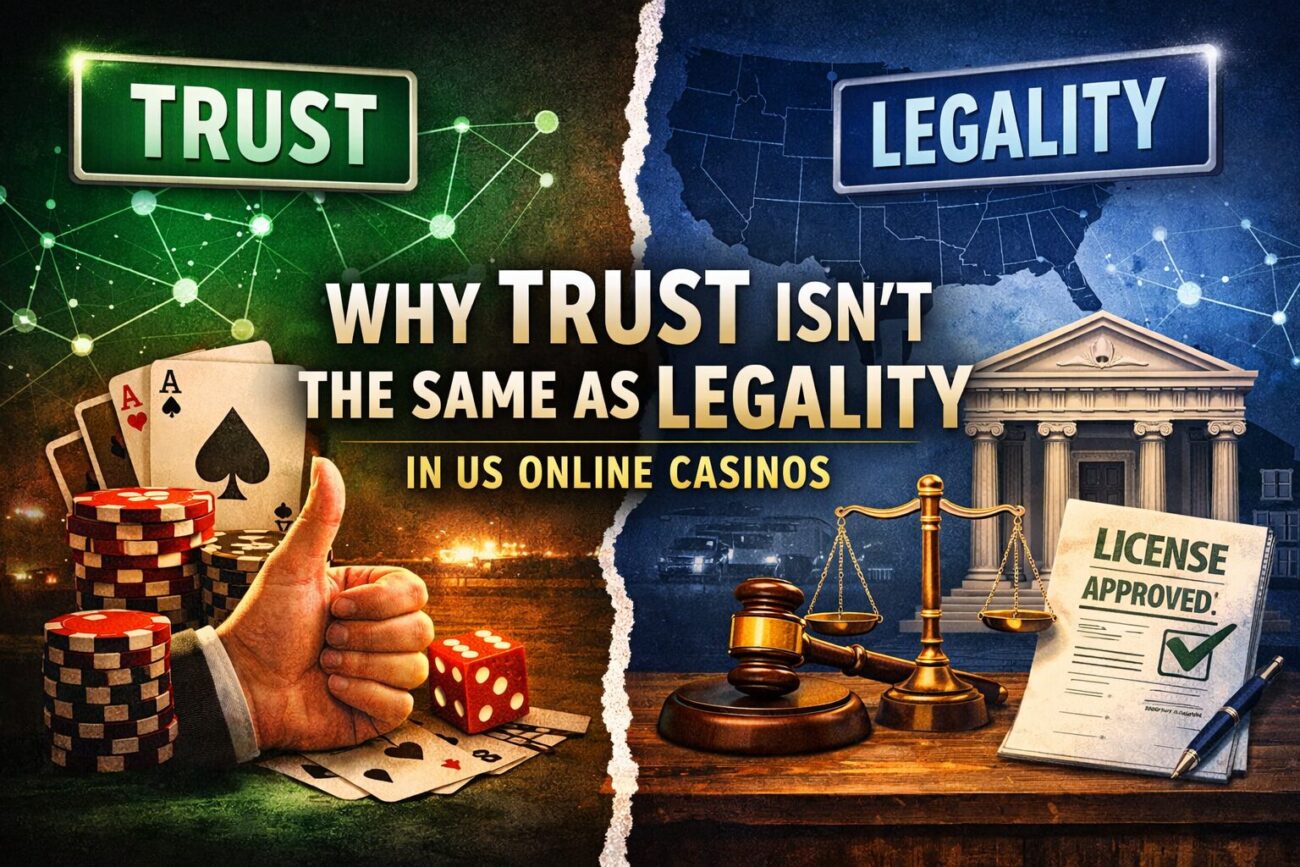
Trust and legality are often treated as the same thing in discussions about US online casinos. In practice, they developed along different timelines and were shaped by different forces. The disconnect is not primarily about players ignoring regulation, but about how online gambling emerged in the United States before a clear, state-based legal framework existed.
In the early years, trust formed through continued operation rather than formal authorisation. Brands such as Bodog became familiar because they worked at a time when regulated alternatives were limited or absent. When federal enforcement later disrupted that momentum and reshaped access, recognition carried forward independently of legality. State-licensed casinos arrived much later, entering a market where trust had already been established elsewhere.
TL;DR: In the United States, trust in online casinos developed before clear state-level regulation existed. Players learned to judge reliability through experience, continuity, and familiarity rather than legal authorisation. When state-regulated casinos later emerged, legality did not automatically replace those established trust signals. As a result, trust and legality evolved on separate tracks, shaped by timing, fragmented access, and jurisdictional boundaries rather than by player attitudes toward regulation.
How Trust Formed Before Regulation
In the early 2000s, online gambling in the United States developed in an environment with little practical regulation and no unified licensing framework. Players did not encounter casinos as “legal” or “illegal” in any meaningful sense. They encountered platforms that either worked or did not. Access, payouts, and continuity mattered more than formal status because there was no widely visible regulatory benchmark to reference.
Trust emerged through repetition. Platforms that remained available over time, processed withdrawals, and maintained a stable user experience became familiar by default. This form of trust was experiential rather than institutional. It was built through use, word of mouth, and survival across years when many operators appeared briefly and disappeared just as quickly.
That dynamic created a trust layer before legality was clearly defined. By the time regulation began to take shape at the state level, many players already had an internal framework for assessing reliability that did not depend on licensing or oversight. Trust had been assigned long before legal categories were formalised, and it would continue to operate independently once they were.
What Legality Means in the US Context
Legality in the United States is defined narrowly and locally. Online casinos are considered legal only where they are explicitly authorised and licensed by a state regulator. There is no nationwide online casino licence, and no single federal body that grants permission to operate across state lines. As a result, legality is tied to jurisdiction rather than to the operator itself.
Where online casinos are permitted, they operate under detailed regulatory frameworks enforced by bodies such as the New Jersey Division of Gaming Enforcement and the Pennsylvania Gaming Control Board. These regulators oversee licensing, auditing, player protections, and compliance with state law. A platform may be fully legal in one state, unavailable in another, and prohibited elsewhere, even if the product and branding appear identical to players.
This structure makes legality precise but fragmented. It communicates compliance to regulators and financial institutions, not necessarily familiarity to users. Unlike trust, which accumulates through exposure and experience, legality begins and ends at the state boundary, creating a formal status that does not automatically translate into recognition or confidence for players operating across a patchwork of markets.
Why Trust Did Not Reset When Regulation Arrived
When state-regulated online casinos began launching in the late 2010s, they did not replace an empty market. They entered a landscape where player habits and perceptions were already established. Regulation introduced legal clarity, but it did not undo years of experience that had shaped how players evaluated reliability.
State launches were incremental and geographically limited. Each regulated market opened in isolation, often with different operators, branding, and platform rules. For players outside those states, regulated casinos were inaccessible. Even within regulated states, newly licensed platforms had no shared history with users. From a player’s perspective, they were unfamiliar products, regardless of their legal status.
Trust, by contrast, is cumulative and slow to change. It forms through repeated outcomes over time and is not reassigned automatically when a new framework appears. Regulation altered what was permitted, but it did not overwrite memory. As a result, legality and trust continued to operate on separate tracks: one defined by statutes and licences, the other by continuity, recognition, and past experience.
Offshore Casinos and Recognition Without State Licensing
Offshore casinos played a central role in shaping player familiarity in the United States, particularly during periods when regulated domestic options were unavailable or limited. These platforms were typically licensed outside the US, operating under jurisdictions such as Curaçao or overseen by bodies like the Kahnawà:ke Gaming Commission. While this licensing did not confer legal status within US states, it provided a form of operational continuity that players encountered repeatedly.
Because offshore platforms were accessible across state lines, they accumulated visibility in a way state-regulated casinos could not. A player’s location did not determine availability, and branding remained consistent regardless of jurisdiction. Over time, this ubiquity reinforced recognition. Players learned to associate certain names with working deposits, functioning withdrawals, and uninterrupted access, even though those platforms sat outside US regulatory systems.
This distinction is important. Offshore casinos were not trusted because they were legal in the United States, but because they were present and persistent. Their recognition emerged from exposure rather than authorisation. When state-licensed casinos later entered the market, they did so within fixed borders and limited timelines, while offshore brands carried forward a broader, longer-established footprint in player awareness.
Why Legal Casinos Often Feel Less Familiar
State-licensed online casinos entered the US market with clear regulatory backing but limited historical presence. Most launched after 2018, operating only within the boundaries of individual states and often under different brand names or skins depending on jurisdiction. This fragmented rollout limited repeated exposure, even for players living in regulated states.
Brand continuity also worked differently in regulated markets. Platforms such as BetMGM or DraftKings may be widely recognised at a national level, but their online casino offerings are not universally available. A player may encounter a brand through sports betting, advertising, or media coverage without ever interacting with its casino product, or may only encounter it after relocation or market expansion.
As a result, legality did not translate into familiarity in the same way trust had earlier. Regulated casinos were compliant and supervised, but they lacked the accumulated exposure that had shaped player perception in the pre-regulation era. For many users, these platforms were legally established yet experientially new, reinforcing the separation between formal status and personal confidence.
Trust Signals and Legal Signals Operated Separately
Trust and legality rely on different signals, and in the US online casino market those signals evolved independently. Trust was shaped by outcomes players could observe directly. Platforms that processed withdrawals reliably, remained accessible over time, and behaved predictably became associated with dependability. These signals were informal, experiential, and reinforced through repeated use rather than external validation.
Legal signals functioned differently. Licensing, regulatory oversight, and compliance mechanisms are designed to communicate legitimacy to institutions and regulators, not to replicate the forms of reassurance players had learned to rely on earlier. A state licence confirms that a casino meets statutory requirements within a specific jurisdiction, but it does not convey longevity, continuity, or familiarity in the way lived experience does.
Because these signal systems developed on separate tracks, one did not replace the other. Trust did not automatically transfer when legality arrived, and legality did not negate existing perceptions of trust. Players continued to interpret reliability through the lens they already understood, while regulation introduced a parallel framework that addressed compliance without reshaping established habits or expectations.
Why the Confusion Persists in Language and Search
The separation between trust and legality is reflected in how US players talk about online casinos and how they search for information. Questions such as “Is this casino legit?” are often used as a catch-all, even though they can refer to very different concerns. For some users, legitimacy means reliability or payout history. For others, it means legal authorisation within a specific state. The same word is used to describe both, which obscures the distinction.
Search behaviour reinforces this overlap. Players frequently encounter familiar brand names that are widely discussed but not state-licensed, alongside newer regulated platforms that are legal but unfamiliar. Because the market developed unevenly, users are left to reconcile two parallel systems of evaluation using imprecise language. The result is repeated confusion, not because the information is unavailable, but because trust and legality are being asked to answer the same question.
This ambiguity persists because neither framework fully replaces the other. Legal status answers whether a casino is authorised to operate in a jurisdiction. Trust answers whether players expect it to function reliably. When those answers diverge, language collapses them into a single concept, even though they describe different aspects of the same activity.
What the Distinction Reveals
The gap between trust and legality in US online casinos is not a contradiction. It is the outcome of timing, access, and structure. Trust formed first, in a period when regulation was absent or unclear, and it did so through experience rather than authorisation. Legality arrived later, confined to state boundaries and communicated through institutional channels that players had not previously relied on.
Because these systems developed independently, neither displaced the other. Regulation clarified what was permitted, but it did not redefine what felt familiar. Trust continued to operate as a historical record of outcomes, while legality functioned as a formal classification tied to jurisdiction. The persistence of both reflects how markets evolve when regulation follows use rather than preceding it.
Understanding this distinction helps explain why recognition and compliance do not always align in the US market. The separation is structural, not attitudinal. It arises from how online gambling was accessed, interrupted, and later formalised, leaving trust and legality to coexist without fully converging.