
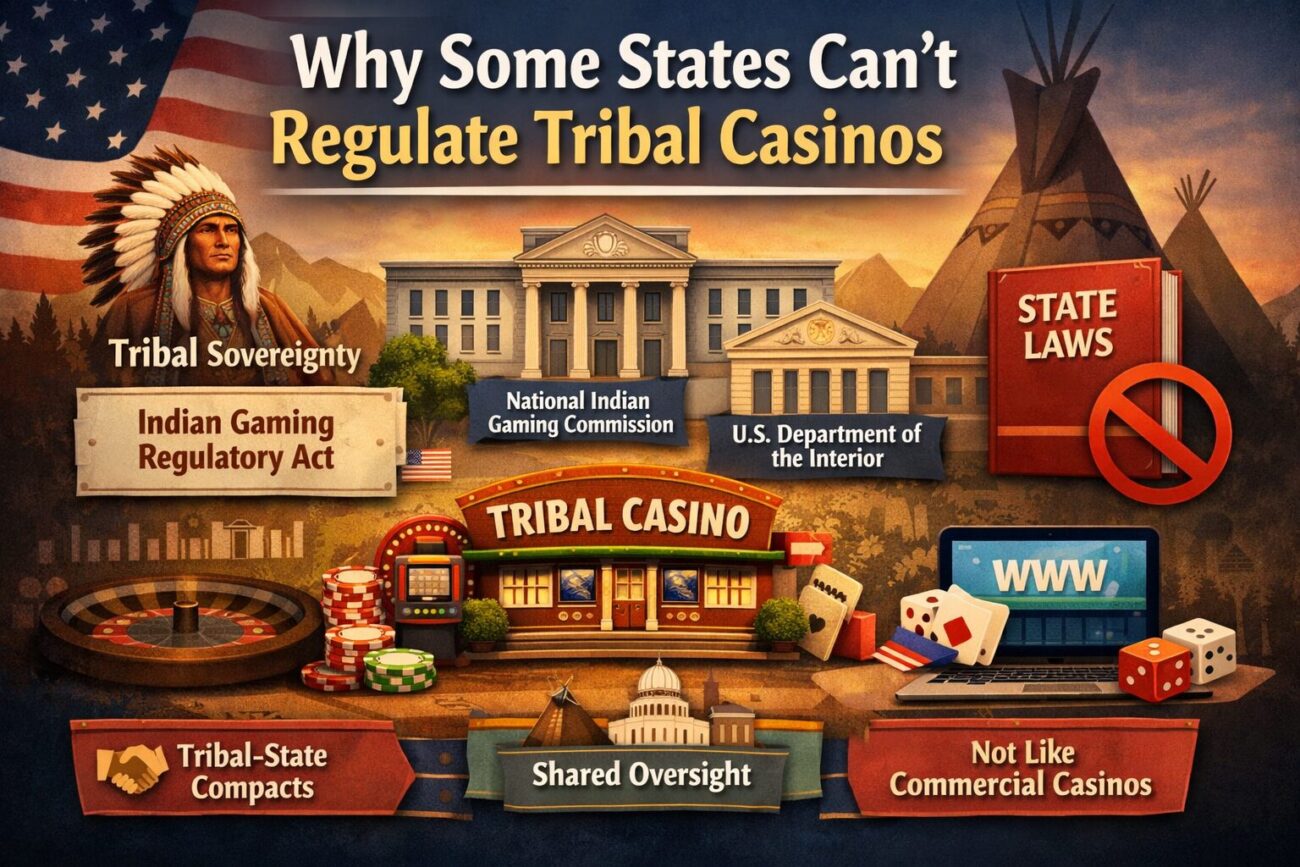
In the United States, gambling is generally regulated at the state level. That framework explains why online casino laws vary from one jurisdiction to another, but it does not apply uniformly to every type of casino. Tribal casinos operate within a different legal structure, one that limits how and when states can impose regulatory authority.
This distinction exists because tribal gaming is governed under a federal framework that recognises tribal governments as sovereign entities. Instead of being licensed and regulated directly by state agencies in the same way commercial casinos are, tribal gaming is conducted through negotiated agreements between tribes and states. These agreements define the scope of state involvement, meaning regulatory power comes through compact terms rather than through automatic application of state gambling statutes.
Understanding why some states cannot regulate tribal casinos in the same way they regulate commercial operators requires looking at this jurisdictional design. The system reflects how federal law, tribal sovereignty, and state interests intersect, creating a model where authority is shared, negotiated, and structured differently from the standard state-by-state approach.
TL;DR: Some states cannot directly regulate tribal casinos because tribal gaming operates under a federal framework that recognises tribal sovereignty rather than ordinary state authority. Under the Indian Gaming Regulatory Act, casino-style gaming on tribal lands is governed through tribal-state compacts, with oversight shared between tribal governments, federal bodies, and negotiated state roles. State gambling laws do not automatically apply in the same way they do to commercial casinos, so regulation flows through compact terms instead of unilateral state control. This jurisdictional structure also shapes how online casino expansion is handled in compact-heavy states.
The Legal Foundation: Tribal Sovereignty
The reason states cannot directly regulate many tribal casinos begins with the concept of tribal sovereignty. Federally recognised tribes are considered distinct political entities with their own governing authority. They are not subdivisions of state government, and state law does not automatically extend into tribal affairs in the same way it applies to private businesses operating off tribal lands.
This framework is formalised in the Indian Gaming Regulatory Act, which established how casino-style gaming could operate on tribal lands. Rather than placing tribal casinos under routine state regulatory control, the law created a structure that recognises tribal authority while allowing states to participate through negotiated agreements. Authority over tribal gaming therefore originates in federal statute and tribal governance, not solely in state legislation.
As a result, states cannot simply apply their gambling statutes to tribal casinos by default. Any state role in regulating casino-style gaming on tribal lands must flow through the mechanisms defined in federal law, which are designed to balance tribal self-governance with state and federal interests rather than to place tribes under unilateral state oversight.
What the Federal Framework Actually Established
The Indian Gaming Regulatory Act did not place all tribal gaming under a single regulator. Instead, it created a tiered structure that divides gaming into different classes, each with its own governance model. This system explains why casino-style gaming on tribal lands does not fall automatically under standard state control.
Class I gaming, which includes traditional or ceremonial tribal games, is governed exclusively by tribes. Class II gaming, such as certain bingo-style games, is primarily under tribal authority with federal oversight. The most relevant category for casino operations is Class III gaming, which covers slot machines and table games. For this class, the law requires a tribal-state compact before gaming can occur, making regulation a matter of negotiated agreement rather than unilateral state licensing.
Oversight at the federal level involves bodies such as the National Indian Gaming Commission, while compact agreements are reviewed within the federal system, including through the U.S. Department of the Interior. This layered approach means authority over tribal casinos is shared across tribal, federal, and compact-based state roles, rather than resting entirely with state gambling regulators.
Why State Gambling Laws Don’t Automatically Apply on Tribal Lands
State gambling laws generally apply to commercial casinos because those businesses operate under state jurisdiction. Tribal casinos, however, operate on lands that fall within a different legal relationship. While tribal lands are geographically within state boundaries, they are not governed in the same way as non-tribal property for regulatory purposes. This distinction limits the automatic reach of state statutes.
Because tribes are recognised as sovereign governments, states cannot unilaterally impose their gambling regulatory systems onto tribal operations. Licensing schemes, tax structures, and enforcement mechanisms that apply to private operators do not transfer by default. Instead, state involvement in tribal casino regulation must be grounded in the terms of a negotiated compact. Without such an agreement, states do not have the same authority they exercise over commercial gaming establishments.
This structure means that regulatory power over tribal casinos is conditional and defined by agreement rather than assumption. State law can play a role, but only to the extent that it is incorporated into compact terms or recognised within the federal framework. The result is a system where jurisdiction is shared and structured differently from the standard model of state oversight seen in commercial casino markets.
Example: California – State Oversight Operates Through Compacts
California illustrates how state involvement in tribal casino gaming is structured differently from its role with commercial gambling. The state has extensive authority over cardrooms and other non-tribal gambling operations through agencies such as the California Gambling Control Commission. Tribal casinos, however, do not receive standard state gambling licences in the same way these commercial venues do.
Instead, tribal casino operations in California are governed through negotiated tribal-state compacts. These agreements define which games may be offered, how revenue-sharing arrangements work, and what regulatory standards apply. State authority over tribal casinos therefore flows through the compact terms rather than through direct application of California’s general gambling statutes. The state’s role is real, but it is mediated and limited by the negotiated framework.
This model shows how tribal casinos can operate within a state’s borders without falling fully under the state’s ordinary regulatory system. Authority exists, but it is structured through agreement rather than imposed unilaterally, reflecting the balance between tribal sovereignty and state interests established at the federal level.
Example: Oklahoma – Authority Flows Through Compact Terms
Oklahoma is another state where tribal gaming is central to the gambling landscape, and where regulation operates through negotiated agreements rather than direct state control. Tribal casinos in the state function under compact arrangements that define what types of gaming are permitted and how revenue terms are structured. State authority over these operations is therefore tied to the scope of those agreements rather than to standard licensing powers.
Discussions in Oklahoma have often focused on how existing compact terms are interpreted or renewed, rather than on the state imposing new regulatory rules unilaterally. Tribal gaming organisations, such as the Oklahoma Indian Gaming Association, represent the collective interests of tribes within this framework. The structure illustrates how changes to oversight or financial terms typically occur through negotiation, not through direct legislative extension of state gambling laws.
This example highlights the limits of state jurisdiction in compact-heavy environments. Even where a state has broad authority over commercial gambling, its role in tribal gaming is bounded by federal law and the terms of negotiated agreements. Regulation is exercised, but through the compact relationship rather than through the standard mechanisms applied to non-tribal casinos.
Example: Florida – Compact Structure Defines State Involvement
Florida provides a clear illustration of how state authority over tribal casinos is channelled through compact agreements. The gaming framework between the state and the Seminole Tribe of Florida establishes the scope of casino-style gaming and the terms under which it operates. Rather than licensing the tribe in the same way it would a commercial operator, the state’s role is defined by the negotiated compact and the federal approval process associated with it.
Legal and political disputes in Florida have centred on the validity and interpretation of compact terms, not on the state asserting direct regulatory control. This reflects the underlying structure: when questions arise about the extent of permissible gaming, they are addressed through the compact framework and federal review channels rather than through unilateral state enforcement of general gambling statutes.
Florida’s experience shows how tribal gaming oversight differs from the standard state model. State involvement is significant, but it operates through a specific legal pathway created by federal law and negotiated agreements. This reinforces the broader point that regulation of tribal casinos is structured differently from regulation of commercial gaming within the same state.
How Compacts Replace Direct State Regulation
For commercial casinos, states typically regulate through licensing systems, agency oversight, inspections, and direct enforcement of state gambling laws. Tribal casinos follow a different model. Instead of being licensed by a state regulator in the ordinary sense, they operate under the authority of tribal governments, with state involvement defined through compact terms.
Tribal gaming operations are commonly overseen by tribal gaming commissions, which handle licensing, compliance, and internal controls within the tribal framework. Federal oversight is also part of the structure, with bodies such as the National Indian Gaming Commission playing a role in the broader regulatory environment. The state’s authority enters the picture only to the extent that it is negotiated and incorporated into the compact agreement.
This means compacts function as the bridge between tribal sovereignty and state interests. They specify what games may be offered, how regulatory standards are applied, and how revenue arrangements are structured. Rather than states directly regulating tribal casinos in the same way they regulate commercial venues, compacts create a tailored framework where oversight is shared and structured through agreement rather than imposed by default.
Why This System Exists
The structure limiting direct state regulation of tribal casinos reflects broader principles built into federal law. Tribal governments are recognised as sovereign entities with the authority to govern their internal affairs. The federal framework was designed to respect that status while also creating a pathway for casino-style gaming to operate in coordination with state interests rather than in conflict with them.
This system also supports economic development goals. Casino gaming has become a significant source of revenue and employment for many tribes, and the legal structure provides a stable basis for those operations to function. By placing the foundation of authority in federal law and negotiated agreements, the model seeks to balance tribal self-governance with oversight and cooperation rather than placing tribes under unilateral state control.
As a result, the compact-based system is not an exception layered onto state regulation, but a parallel governance model. It was created to recognise the distinct legal position of tribes while allowing states to participate through agreement. The outcome is a regulatory landscape where authority is distributed differently from the commercial casino sector, reflecting the intersection of sovereignty, federal policy, and state interests.
What This Means for Online Gaming
The same jurisdictional structure applies when gambling moves online. States cannot simply extend their online casino laws to tribal operators in the same way they regulate commercial platforms. If digital casino gaming is introduced in a state with tribal gaming, the role of tribes must be addressed within the compact framework rather than through unilateral state regulation.
Online expansion can raise new questions about scope, exclusivity, and regulatory authority. If a state authorises internet casino gaming outside existing compact terms, tribes may view that as affecting previously negotiated rights tied to casino-style gaming. As a result, online policy in these states often requires compact amendments or new agreements that define how digital gaming fits into the established structure.
This helps explain why online casino legalization progresses differently across states. In compact-heavy environments, the path to iGaming is shaped not only by legislative support but also by how digital gambling aligns with tribal agreements. The pace and design of online frameworks therefore reflect the same jurisdictional balance that governs land-based tribal casinos.