
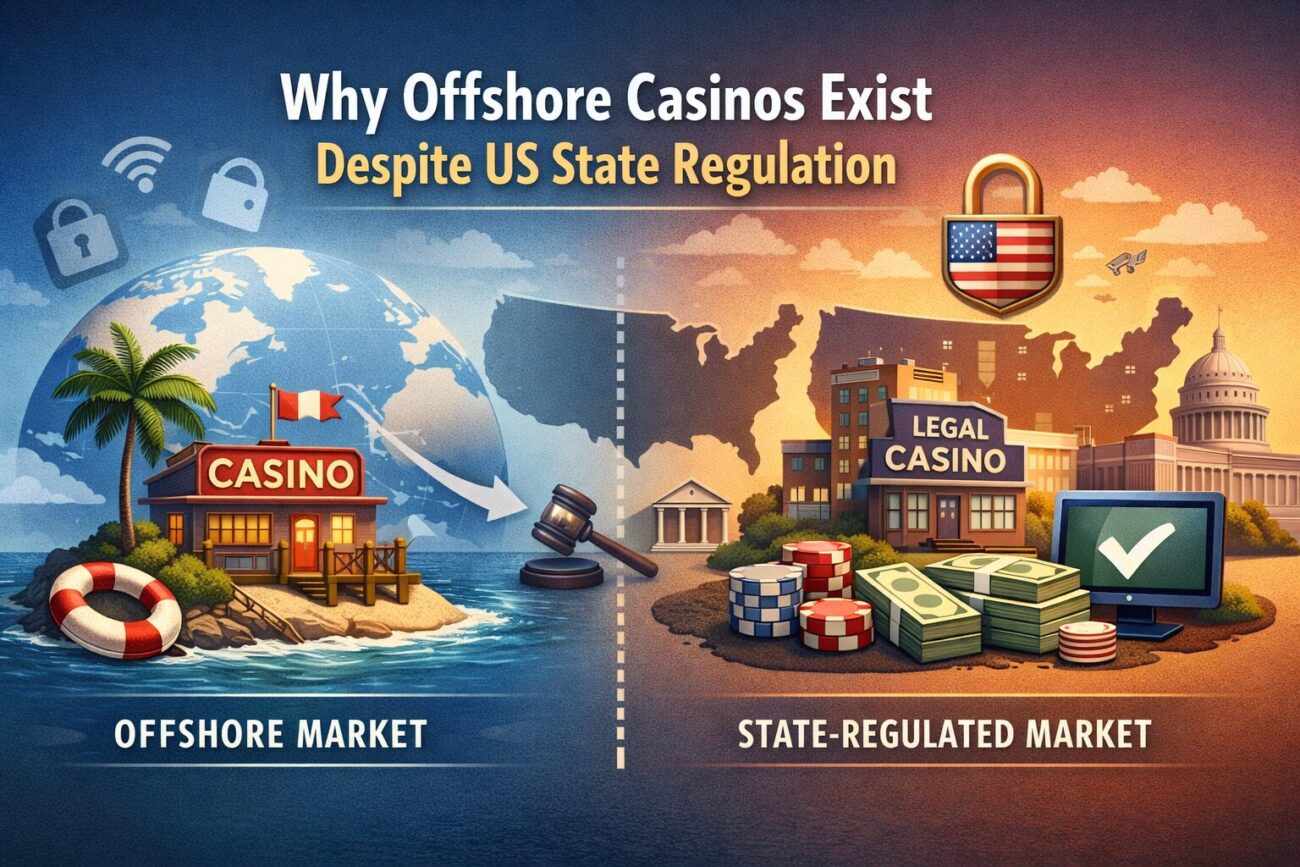
Players in the United States are often told that online casinos are regulated at the state level, yet they still encounter offshore casino sites that accept US players. This can appear contradictory, particularly in states where regulated online casinos already operate.
The explanation lies in how jurisdiction works. State regulation applies only within a state’s legal and territorial boundaries, and it governs operators that choose to submit to that authority. It does not extend automatically to companies licensed and operated outside the United States, even when their websites are accessible from within it.
Federal law does not fill this gap with a national licensing or prohibition framework. Instead, it focuses on specific risks such as interstate transmission and payment processing, leaving large areas of online activity governed by territorial limits rather than universal rules. As a result, state-regulated markets and offshore operators exist in parallel rather than in direct competition.
We explain why offshore casinos continue to exist alongside state-regulated online casinos, and how legal jurisdiction, rather than regulatory failure, shapes that outcome.
TL;DR: Offshore casinos continue to exist alongside state-regulated US online casinos because regulation is territorial, not universal. State laws apply only to operators licensed within a state’s borders, and federal law does not create a national system that licenses or bans online casinos outright. As a result, offshore operators based and licensed outside the United States sit beyond direct state authority.
Federal laws like the Wire Act and UIGEA shape access and payments rather than eliminating offshore casinos altogether. They create friction and instability but do not remove foreign operators from the global market. The outcome is a parallel system: tightly regulated, state-licensed casinos operating locally, and offshore casinos operating internationally under different rules. This coexistence is a structural feature of jurisdictional limits, not a regulatory failure.
What State Regulation Actually Covers
State regulation of online casinos is territorial by design. When a state legalises online gambling, it establishes authority over operators that are licensed within that state and that conduct gambling activity while players are physically located there.
This authority is enforced through licensing requirements, compliance audits, and technical controls. Operators must maintain approved systems, submit to regulatory oversight, and ensure that gameplay, data handling, and payments comply with state law. These obligations apply only to activity that occurs within the state’s jurisdiction.
What state regulation does not do is extend beyond those borders. A state regulator cannot license, supervise, or discipline an operator that has no legal presence in that state. It cannot impose requirements on companies incorporated abroad, nor can it enforce its rules against entities that do not rely on state infrastructure or approval.
This creates a clear boundary. State regulation is effective and comprehensive where it applies, but its reach is intentionally limited. Offshore casinos exist outside that reach, not because they bypass state rules, but because those rules were never designed to govern activity beyond state jurisdiction.
Why Federal Law Does Not Eliminate Offshore Casinos
Federal law places limits on certain forms of gambling activity, but it does not create a system that licenses or directly governs online casinos on a national basis. Its role is narrower, focusing on specific risks rather than market control.
One of the relevant statutes is the Wire Act of 1961, which restricts certain types of interstate wagering transmission. The law was written to address domestic activity that crosses state lines, and it does not establish authority over gambling operators based outside the United States. As a result, it constrains how gambling is conducted within the country rather than determining whether foreign casinos may exist.
Another is the Unlawful Internet Gambling Enforcement Act, which targets the financial system rather than gambling operations themselves. UIGEA places obligations on banks and payment processors, limiting their ability to facilitate transactions connected to unlawful gambling. It does not license casinos, and it does not prohibit foreign operators from offering services over the internet.
Together, these laws shape participation rather than existence. They make certain forms of access more difficult and introduce friction around payments and transmission, but they do not remove offshore casinos from the global market. Federal law sets boundaries around domestic involvement, leaving offshore operators outside its direct regulatory reach.
This explains why offshore casinos persist alongside state-regulated markets. The legal framework limits what happens within the United States, but it does not extend far enough to eliminate operators that sit entirely beyond US jurisdiction.
Jurisdiction Is the Core Issue
The continued presence of offshore casinos is best explained through jurisdiction rather than legality. Laws apply within defined territorial limits, and enforcement authority generally stops at national borders.
Offshore casinos operate under licences issued by foreign jurisdictions, and they are incorporated, hosted, and managed outside the United States. Because they do not rely on state approval and do not maintain a legal presence within a US state, state regulators have no direct authority over them. Oversight exists where the operator is based, not where a player happens to access a website.
Federal jurisdiction is similarly limited. While US law can regulate domestic actors and financial institutions, it does not grant blanket authority over foreign companies that do not operate within US territory. Enforcement against offshore operators is therefore indirect, relying on payment restrictions, access limitations, or cooperation with foreign authorities rather than direct supervision.
This creates a structural divide. State-regulated casinos operate within tightly controlled legal environments, while offshore casinos operate in parallel under different regulatory regimes. The distinction is not one of intent or loopholes, but of jurisdictional reach, and that reach determines who can be regulated and how.
Why Offshore Casinos Still Accept US Players
Offshore casinos are not bound by US state licensing requirements, and their decision to accept US players is shaped by how jurisdiction and enforcement work in practice. Operating outside the United States places them beyond the direct reach of state regulators, even when their websites are accessible from within US borders.
Many offshore operators are licensed in jurisdictions that permit them to offer services internationally. From their perspective, accepting players from the United States does not automatically trigger US regulatory authority, provided they have no physical presence, infrastructure, or licensing relationship within the country. This creates a legal distinction between access and control.
Enforcement risk also varies by operator. Some offshore casinos adopt conservative policies and restrict US access entirely, while others accept US players based on their assessment of regulatory exposure, payment feasibility, and market demand. The absence of a single national prohibition allows these differences in approach to persist.
This does not mean access is stable or guaranteed. Offshore availability can change without notice, and restrictions are often applied unevenly. Acceptance of US players reflects jurisdictional distance rather than regulatory approval, and that distance shapes how offshore operators evaluate participation in the US market.
The Role of Payments and Access
Payments sit at the point where offshore casinos most directly intersect with the US legal system. While state regulation does not extend offshore, financial transactions often rely on intermediaries that operate within the United States or maintain exposure to US law.
This is where federal constraints matter in practice. Payment processors and banks subject to US regulation are required to avoid facilitating transactions connected to unlawful gambling, which creates friction for offshore operators attempting to serve US players. As a result, payment availability is inconsistent, and methods may change over time as processors adjust their risk tolerance.
Access is shaped by the same uncertainty. Offshore casinos may be reachable through standard internet connections, but availability is not guaranteed and can be restricted by operator policy, payment limitations, or technical controls. These constraints are not coordinated, and they can shift without warning.
The outcome is a market that exists but remains unstable. Offshore casinos can accept US players in some circumstances, but access is often fragile, shaped by payment viability rather than regulatory permission. This instability reflects the indirect nature of enforcement rather than the presence of a clear legal pathway.
How State-Regulated and Offshore Models Differ
State-regulated online casinos operate within defined legal frameworks that prioritise oversight and accountability. Licensing is tied to specific jurisdictions, and regulators have ongoing authority to audit systems, enforce standards, and resolve disputes. Player protections, reporting requirements, and technical controls are embedded into the operating model rather than applied selectively, and the software platforms used are typically developed or adapted to meet those jurisdiction-specific requirements.
Offshore casinos function under a different set of conditions. Oversight is provided by the jurisdiction in which the operator is licensed, and the scope of that oversight varies by regulator. While some offshore regimes impose meaningful standards, enforcement is not coordinated with US state authorities, and remedies are generally pursued through foreign regulatory channels rather than local ones. This environment has also given rise to a distinct group of software providers that specialise in serving offshore operators across multiple jurisdictions rather than complying with state-level US regulation.
These differences affect how issues are handled in practice. Dispute resolution, compliance transparency, and enforcement mechanisms are clearer and more accessible within state-regulated markets, where both operators and their technology providers are subject to local oversight. Offshore models rely more heavily on contractual terms, platform-level controls, and foreign oversight, which can limit recourse and introduce uncertainty for players.
The contrast is structural rather than qualitative. State-regulated and offshore casinos are built to operate under different assumptions about jurisdiction, authority, and enforcement. The software ecosystems that support them reflect those assumptions, helping explain why the two models coexist without converging, even when they appear to serve similar audiences.
Why Offshore Casinos Persist
Offshore casinos continue to exist because they operate in the space created by jurisdictional limits rather than in opposition to state regulation. As long as regulation is territorial and the internet is global, parallel markets are likely to remain.
Demand plays a role. Many US states do not offer regulated online casinos, and players in those jurisdictions have no state-licensed options available to them. Offshore operators fill that gap by offering access where local regulation does not, even though that access sits outside state oversight.
Regulatory fragmentation also contributes. State-by-state rollout has been gradual, and the requirements for licensing and compliance vary widely. For operators based outside the United States, entering regulated state markets can be costly and complex, while continuing to operate offshore may be commercially simpler.
Economic incentives reinforce this pattern. Offshore casinos can operate under regulatory regimes that differ in cost, reporting requirements, and operational constraints. While this comes with trade-offs in terms of access and stability, it allows offshore operators to serve a global audience without tailoring their platforms to individual US states.
These factors combine to create persistence rather than convergence. Offshore casinos are not a temporary anomaly waiting to disappear. They are a predictable outcome of a system where regulation is local, enforcement is territorial, and demand exists beyond the reach of state-licensed markets.