
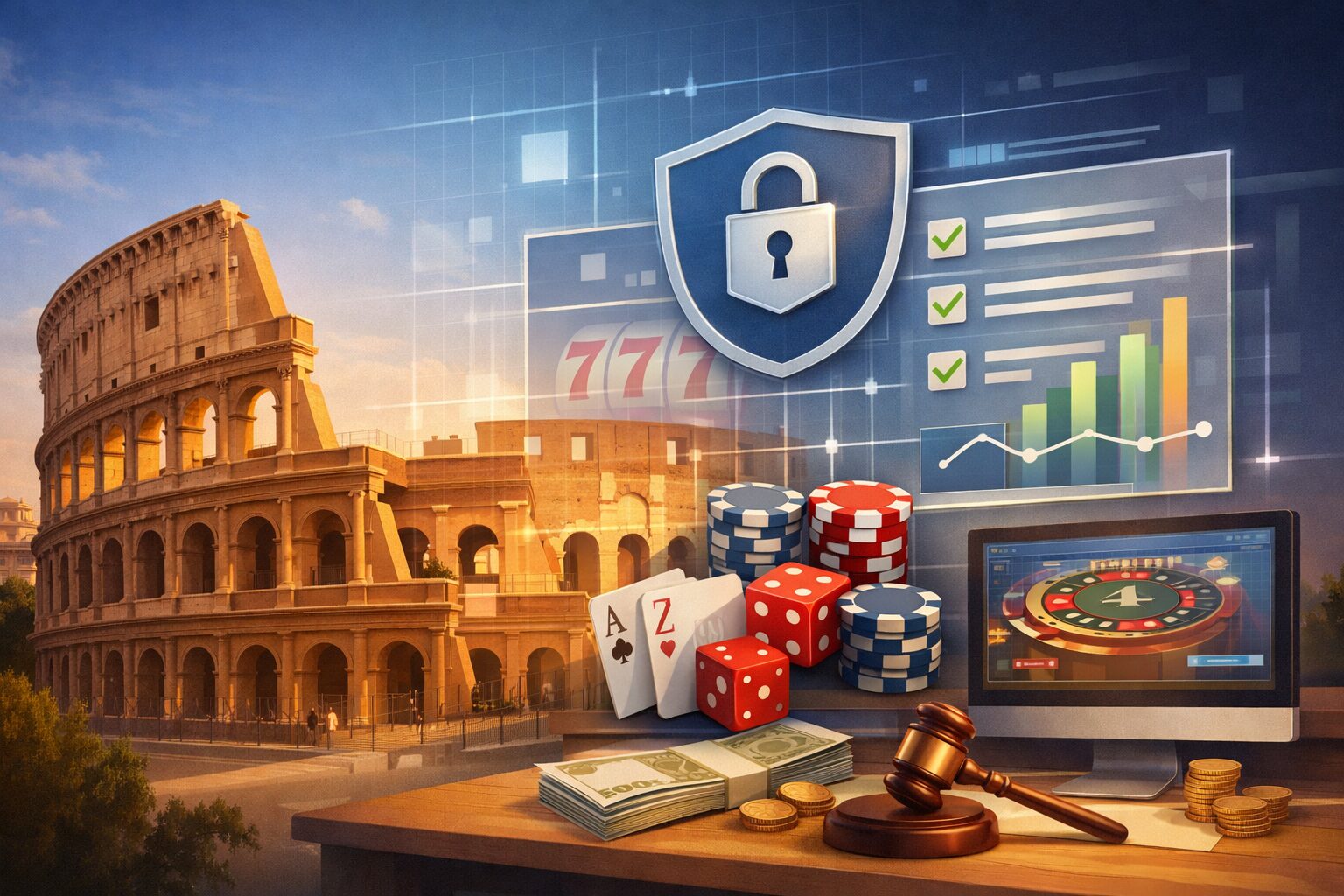
For much of the early online gambling era, Italy had the same problem as many other countries.
Players could already reach online betting and casino sites, but the law had not fully caught up with the technology. Offshore operators were serving Italian customers, while much of that activity sat outside Italy’s licensing, tax and consumer protection systems.
Italy gradually chose regulation over trying to make online gambling disappear.
Instead of treating all remote gambling as something to be driven underground, the country created routes for licensed operators to serve Italian players under national rules. Over time, that system became stricter, with stronger controls around licensing, advertising, player accounts and illegal operators.
That shift shaped the market for online casinos for Italy that exists today.
Italy’s Early Online Gambling Problem
Online gambling reached Italian players before the country had a mature system for regulating it.
The internet made it easy for operators based elsewhere in Europe or offshore to accept Italian customers without opening physical premises in the country. That weakened the link between gambling and the national licensing system that had been built around traditional betting and gaming.
For regulators, the problem was not simply that people wanted to gamble online. The harder problem was that much of that gambling could take place outside the systems Italy used to supervise operators, collect tax and apply domestic rules.
The First Response Was Greater Control
Italy began tightening its approach during the mid-2000s.
The authorities increased action against gambling websites that did not have the required Italian authorisation, including measures designed to block access to unauthorised sites.
At the same time, Italy was also expanding the range of gambling that could be offered legally through licensed channels.
That combination became a central part of the Italian model: restrict the unlicensed market while creating a regulated alternative.
European Law Also Shaped the Market
Italy’s gambling rules were also tested through European Union law.
Cases involving betting operators reached the Court of Justice of the European Union, where parts of Italy’s licensing system were challenged under EU rules on freedom of establishment and the freedom to provide services.
The Court did not say that Italy had to abandon gambling licences or open the market without limits.
Instead, cases such as Placanica and later Costa and Cifone showed that national restrictions still had to be applied in a way that respected EU law, including principles such as equal treatment and transparency.
That put pressure on Italy to make access to the regulated market clearer and more consistent.
The Shift Toward a National Online Licensing System
The major change came as Italy developed a proper framework for remote gambling.
The 2009 law and implementing rules that followed in 2011 created a clearer system for the collection of gambling at a distance. Operators serving Italian players could obtain concessions and operate within a national regulatory structure rather than remaining outside it.
This turned online gambling into a formally supervised part of Italy’s public gambling system.
The basic choice was simple: operators that wanted lawful access to Italian customers had to enter the Italian concession system and follow its rules.
What Licensing Changed
Licensing gave the authorities much greater visibility over online gambling.
Licensed operators had to work through regulated player accounts, follow technical requirements and report activity through systems connected to the Italian gambling authority.
That made remote gambling easier to supervise than a market dominated by offshore websites with no domestic concession.
It also gave Italy a clearer basis for acting against operators that continued serving the market without authorisation.
Italy Did Not Create a Free Market
Legalising online gambling did not mean removing controls.
Italy continued to treat gambling as a regulated activity offered under state concessions rather than as an ordinary online business that anyone could launch.
Operators had to meet the conditions of the Italian system before they could legally offer remote gambling to Italian players.
This remains the basic distinction today: online casinos are legal in Italy, but tightly controlled.
The Regulator Became Central to the System
Oversight eventually sat with the Agenzia delle Dogane e dei Monopoli, usually shortened to ADM.
ADM manages the concession system, publishes lists of authorised remote gambling operators and takes action against illegal gambling offers.
That gives players and operators a clear national reference point.
Instead of legality depending only on where a company happens to be based, the important question is whether it holds the required Italian concession to offer gambling in Italy.
Italy Combined Licensing With Blocking
The regulated market was only one half of the strategy.
Italy also developed systems for identifying and restricting access to websites offering gambling without the required authorisation.
This created a two-sided model. Licensed operators were given a legal route into the market, while unlicensed operators could be targeted more directly because a recognised domestic alternative now existed.
That is different from relying on blocking alone.
The Goal Was Not to Eliminate Gambling Demand
Italy’s system recognised that people were already gambling online.
Trying to remove every gambling website from the internet would not remove that demand, especially when operators could be based outside the country.
The more practical approach was to bring as much activity as possible into channels the state could supervise.
In gambling regulation, this is often described as channelisation: moving players toward licensed operators rather than leaving them in an uncontrolled market.
Why the Licensed Market Became More Attractive
A legal market only works if players are willing to use it.
Italian-licensed operators could compete openly for customers, offer a wide range of remote gambling products and use familiar payment methods within a recognised domestic system.
At the same time, regulators could place more pressure on unauthorised competitors.
That gave Italy a better chance of moving gambling activity into the licensed market than a system based only on prohibition.
It did not eliminate illegal gambling, but it changed the balance between the regulated and unregulated sectors.
Advertising Became the Next Major Battleground
Italy later decided that allowing gambling did not mean allowing unlimited promotion.
The country’s approach became much stricter in 2018 with the so-called Dignity Decree.
The law introduced a broad prohibition on direct and indirect advertising for gambling and betting with cash prizes across television, radio, print, digital media, social media and other channels.
From 2019, the rules also extended to sponsorships.
This was a major change because Italy was no longer only controlling who could offer gambling. It was also controlling how aggressively licensed gambling could be promoted.
Legal Gambling and Gambling Advertising Became Separate Questions
That distinction is important.
An online gambling product can be legal without the operator being free to advertise it in the same way as another consumer service.
Italy kept the licensed market while heavily restricting the ways gambling businesses could market themselves.
This created a model in which access remained legal but promotion became much more limited.
Player Protection Became More Important Over Time
The Italian system also developed stronger controls around player accounts.
Licensed remote gambling works through identifiable accounts rather than anonymous play. Operators therefore have to verify players and comply with rules around account management, financial flows and responsible gambling.
Self-exclusion has also become part of the regulated system, allowing players to restrict their access to licensed gambling accounts.
These tools are easier to apply in a licensed market because operators are required to participate in the same regulatory structure.
Why Licensing Makes Player Protection Easier to Enforce
A rule only has much value if the regulator can identify the company responsible for following it.
With a domestic concession, the regulator knows who the operator is and can attach legal obligations to that licence.
That makes it possible to enforce rules around player identification, account controls and technical standards.
An unlicensed offshore operator sits outside much of that direct relationship.
This is one reason Italy’s licensing model became more than a way to collect tax. It also created an enforcement point for player protection.
The Market Continued to Evolve
Italy did not freeze its online gambling rules after the first licensing reforms.
Remote gambling technology changed, payment methods changed and the market grew, so the legal framework continued to be updated.
In 2024, Italy adopted another major reform through Legislative Decree No. 41.
The law reorganised the remote gambling sector and set out a new concession framework for public gambling offered at a distance.
That shows how established the basic principle has become.
Italy is no longer debating whether remote gambling should exist at all. The debate is mainly about the conditions under which licensed operators are allowed to provide it.
The 2024 Reform Kept the Concession Model
The new legislation retained the idea that remote gambling is a state-regulated activity offered through concessions.
It sets requirements for concession holders and covers areas including remote games, financial flows, player protection and illegal gambling.
Italy has also moved forward with a new procedure for awarding remote gambling concessions under the updated framework.
So the modern system is an evolution of the earlier licensing strategy rather than a reversal of it.
Illegal Gambling Has Not Disappeared
It would be too strong to say that licensing solved Italy’s offshore gambling problem completely.
Unauthorised operators can still attempt to reach Italian customers, and ADM continues to maintain enforcement measures against illegal online gambling.
The difference is that Italy now has a large regulated market sitting beside that enforcement.
Players are not being told simply that they cannot gamble online. They are being directed toward operators authorised within the Italian system.
Why Italy’s Approach Has Lasted
Italy’s model has lasted because it combines access with control.
The country accepts remote gambling through licensed operators, but it places the activity inside a national concession system and continues to act against unauthorised sites.
It has also shown that legalisation does not have to mean liberalisation in every area.
Advertising can be heavily restricted, player controls can become stricter and concession requirements can be raised while online gambling itself remains legal.
From an Offshore Problem to a Regulated Market
Italy’s online gambling history is best understood as a gradual move from limited control toward direct supervision.
When internet gambling first expanded, Italian players could reach operators that sat largely outside the domestic system. Italy responded first by increasing enforcement, then by building clearer routes into a licensed remote market.
European legal challenges helped shape parts of the licensing system, while later reforms strengthened national control. Advertising rules became much stricter, player accounts became more closely regulated and the remote gambling framework continued to develop.
The 2024 reforms show that the basic policy choice remains in place.
Italy has not tried to make online gambling disappear.
It has spent two decades trying to make more of it happen inside a system the state can see, license and regulate.
The defining feature of Italy’s approach is not simply that online gambling is legal. It is that legal access and strict control were built together, allowing the country to regulate an existing online market rather than pretending demand could be removed.
Gavin analyzes online gambling regulation, licensing systems, and market structure across international jurisdictions. With over a decade of experience covering the iGaming sector, his research focuses on how national gambling laws, regulatory authorities, and compliance frameworks shape legal online casino markets. This guide was prepared using primary regulatory sources and official publications from European gambling authorities.