
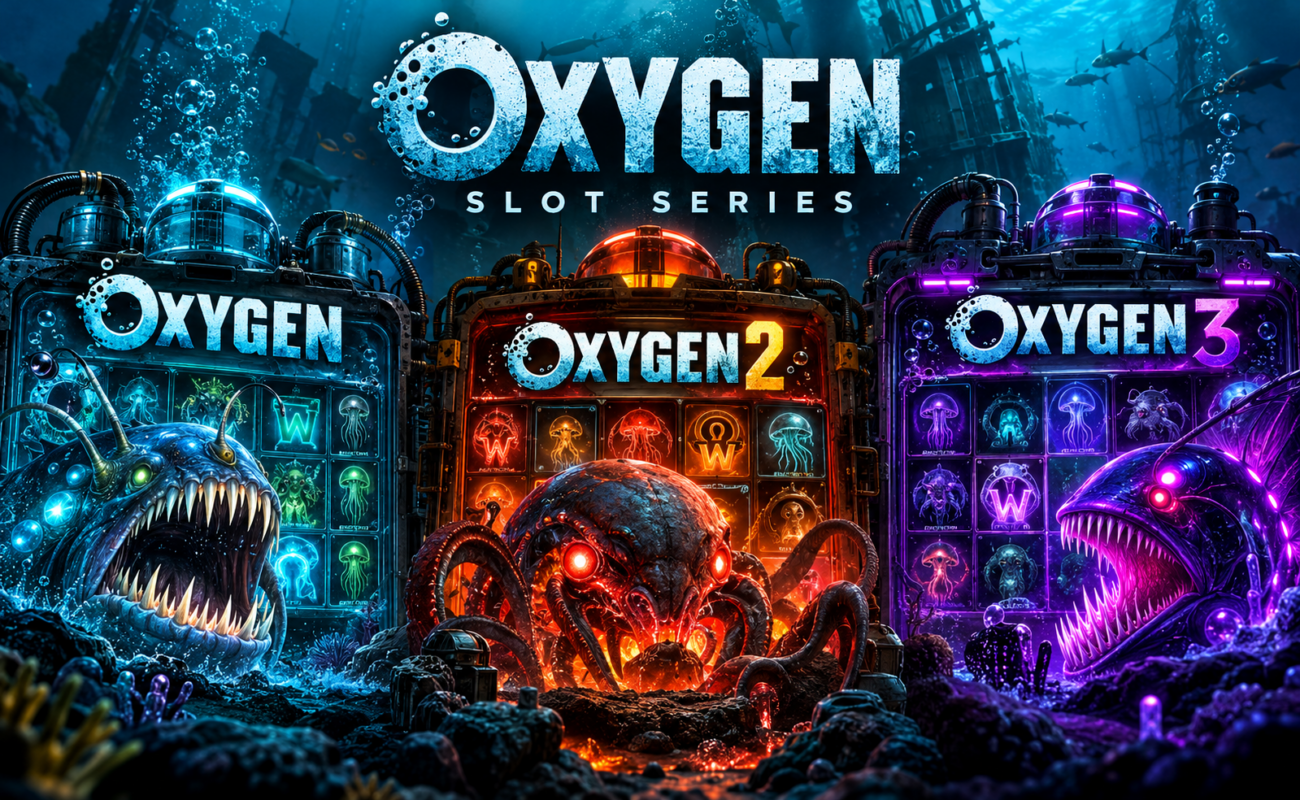
Oxygen has developed into a three-game ELK Studios series without changing its basic 6×7 grid or 25,000x payout potential. The original builds around position multipliers, Collectors and Dealers, Oxygen 2 adds Octopus and Jellyfish features, while Oxygen 3 pushes the multiplier system further with Multiplier Strike, the Oxygen Meter and several new creature-based features.
How Do the Oxygen Slots Compare?
All three Oxygen games use a 6×7 grid and offer up to 25,000x bet, but each sequel changes how multipliers are created and developed across the grid.
| Game | Release | Max Potential | Best For |
|---|---|---|---|
| Oxygen | December 2023 | 25,000x | Original position-multiplier system |
| Oxygen 2 | March 2025 | 25,000x | Octopus and Jellyfish multiplier features |
| Oxygen 3 | April 2026 | 25,000x | Multiplier Strike and Oxygen Meter progression |
The payout ceiling never changes, so the series is not about making each sequel capable of a bigger headline win. ELK Studios instead keeps rebuilding the systems that sit underneath the 25,000x potential, particularly the way multipliers are placed, increased and carried into bonus features.
Our Pick: Oxygen 3
Oxygen 3 is our overall pick because it keeps the 6×7 multiplier foundation while adding Multiplier Strike, the Oxygen Meter and a wider set of creature features that interact directly with the grid.
Oxygen 2 makes the first major expansion through the Octopus and Jellyfish, but Oxygen 3 gives the multiplier system more ways to develop during both normal play and the bonus. It feels like the most complete version of the idea without changing the 25,000x ceiling that has defined the series from the start.
Has the Oxygen Max Win Increased?
No. Oxygen, Oxygen 2 and Oxygen 3 all have the same 25,000x maximum potential.
That makes Oxygen unusual compared with many slot series where each sequel tries to raise the headline payout.
ELK has instead kept the ceiling fixed while making the route toward larger wins more elaborate. The original uses position multipliers, Collector and Dealer features. Oxygen 2 introduces new creatures that add and increase multipliers, while Oxygen 3 adds Multiplier Strike and an Oxygen Meter that can upgrade groups of multipliers during the bonus.
The series has therefore evolved through feature depth rather than a larger maximum prize.
What Stayed the Same Across All Three Oxygen Games?
The 6×7 grid, 25,000x potential and position-based multiplier concept remain at the center of all three games.
The original Oxygen establishes the basic system. Winning combinations increase the multiplier values attached to the positions involved in those wins, so the same areas of the grid can become progressively more valuable.
That idea survives in both sequels. Oxygen 2 calls these positions Oxygen Bubbles and adds features that interact with them, while Oxygen 3 continues to build multipliers on individual positions and introduces another way to place them through Multiplier Strike.
The sequels therefore do not abandon the original mechanic. They give the grid more ways to manipulate it.
How Do Oxygen Bubbles Work in the Original?
Every winning combination doubles the multiplier value on the positions used in that win.
This makes repeated activity on the same areas of the 6×7 grid particularly important. A position that contributes to several wins can become considerably more valuable than one that has not yet been involved.
The Collector feature can gather the multiplier values currently visible on the grid, while the Dealer multiplies values in the direction of its radar. Both features can also become persistent, allowing their effect to remain relevant across more than one drop.
The original is therefore built around developing multiplier values and then using the Collector or Dealer to take advantage of what has accumulated.
What Did Oxygen 2 Change?
Oxygen 2 keeps the position-multiplier idea but gives it new ways to spread and increase through the Octopus and Jellyfish features.
Winning symbols still explode and activate Oxygen Bubbles. If a position already contains an active Bubble, another win increases its multiplier.
The Octopus adds random surrounding multipliers when a win lands on its position. This makes multiplier development less dependent on repeatedly winning on exactly the same locations, because the feature can add value to nearby positions as well.
The Jellyfish works differently. It moves across a random number of positions and increases the Oxygen Bubble multipliers it reaches, while also having the potential to increase its own multiplier.
Oxygen 2 therefore expands the multiplier system from something mainly driven by winning positions into a grid where special creatures can directly alter surrounding values.
How Does the Oxygen 2 Bonus Work?
Three Bonus symbols trigger the Free Drop Bonus Game, where existing multipliers become persistent and the Octopus remains active throughout the feature.
Any multiplier values already built before the bonus are carried into it rather than being reset. The Octopus also becomes persistent and moves to a new random position during every Free Drop, creating repeated chances to add surrounding multipliers.
Four Bonus symbols trigger the Super Bonus instead. In that version, the Jellyfish feature activates during every Free Drop.
This gives Oxygen 2 a clear difference between its two bonus levels. The standard Bonus emphasizes a persistent Octopus moving around the grid, while the Super Bonus repeatedly brings the Jellyfish into play.
Did Oxygen 2 Improve the Wild Features?
Oxygen 2 changes both major Wild features and gives them more flexible effects across the grid.
The original X-Blaster Wild selects a payout symbol or Wild and replaces payout symbols in an X-shaped area. Oxygen 2 changes this to a Blaster Wild that can work in either an X or Plus shape, replacing affected symbols with the selected payout symbol.
The Exploding Wild also changes. In Oxygen 2, it removes payout symbols in two cone-shaped areas either horizontally or vertically.
A Super Exploding Wild can go further by activating Oxygen Bubbles behind the symbols it removes. That connects the Wild feature directly back to the central multiplier system rather than using symbol removal as an isolated effect.
What Does Oxygen 3 Change?
Oxygen 3 makes multiplier development more active by adding Multiplier Strike and several new creature features that can change both symbols and multiplier values.
Winning on the same positions still builds multipliers, so the core Oxygen idea remains intact. The major addition is Multiplier Strike, which can activate during any drop and place extra multipliers directly onto the grid.
That gives the third game another way to create valuable positions without relying only on previous winning combinations.
Oxygen 3 then adds the Clam, which can trigger one of three different creature features when it becomes part of a win. These features can create Wilds, extend Redrops, remove symbols and increase multiplier values.
The grid therefore has more moving parts than in the original, but nearly all of them still feed back into the same central goal of building stronger positions.
What Does the Clam Do in Oxygen 3?
The Clam can trigger the Pearl, Squid or Starfish, with each feature changing the grid in a different way.
The Pearl selects one payout symbol. Redrops then continue for as long as more of that selected symbol or Wild symbols keep landing.
The Squid creates a Wild on its current position before moving elsewhere, allowing Wild symbols to be introduced across different parts of the grid.
The Starfish is more directly tied to the multiplier system. It removes symbols, increases multiplier values and then becomes a Wild itself.
The Clam therefore acts as a gateway to several different effects rather than representing one fixed feature. That gives Oxygen 3 more variety during normal play without losing the multiplier-focused structure of the earlier games.
How Does the Oxygen Meter Work?
The Oxygen Meter fills when wins land during the Bonus Game and upgrades a cluster of multipliers once it reaches capacity.
This is one of the clearest additions in Oxygen 3 because it gives the Bonus Game its own visible progression system.
Earlier Oxygen games make existing multiplier values important during their bonuses, particularly through persistence. Oxygen 3 adds another objective: every win contributes to filling the meter.
Once the Oxygen Meter is full, a group of multiplier positions on the grid is upgraded. The bonus therefore becomes less dependent on waiting for one special creature to appear because ordinary wins also move the player toward a larger multiplier event.
Which Oxygen Game Has the Best Multiplier System?
Oxygen 3 has the deepest overall multiplier system, while the original has the simplest and easiest version to follow.
The first Oxygen mainly asks you to build multipliers by winning repeatedly on the same positions and then benefit from Collector or Dealer effects.
Oxygen 2 expands that idea by giving the Octopus and Jellyfish direct control over multiplier placement and growth. Those features make the grid more dynamic because multiplier values can develop around special symbols rather than only through ordinary winning combinations.
Oxygen 3 adds another layer through Multiplier Strike, which can place additional multipliers during any drop, while the Starfish and Oxygen Meter can increase them further.
The same basic idea runs through all three games, but the number of ways to manipulate the grid increases with each release.
What Stands Out
ELK has kept both the 6×7 grid and 25,000x payout ceiling unchanged while rebuilding almost everything that controls how multipliers develop.
That makes the evolution of Oxygen unusually easy to isolate. The series does not become larger or offer a higher maximum win. Instead, each game adds more ways to create, move, increase and preserve multiplier values across the same 42 grid positions.
Which Oxygen Game Has the Better Bonus?
Oxygen 3 has the most structured Bonus Game, while Oxygen 2 has the clearest difference between its standard Bonus and Super Bonus.
The original carries all multiplier values into the Bonus Game and keeps them persistent. Triggering the Super Bonus requires three Bonus symbols together with at least one persistent multiplier symbol.
Oxygen 2 carries existing multipliers into the bonus as well, but it also makes the Octopus persistent and moves it to a new position during every Free Drop. The Super Bonus guarantees the Jellyfish feature on every Free Drop, giving the two bonus levels clearly different behavior.
Oxygen 3 adds the Oxygen Meter, which fills as wins land and eventually upgrades a cluster of multiplier positions. This means the bonus itself has a progression target rather than relying solely on persistent values or repeated special features.
For players who prefer a feature that visibly develops as it continues, Oxygen 3 has the strongest bonus structure.
How Did X-iter Change Across the Oxygen Series?
All three games offer five X-iter modes, but Oxygen 3 reduces the cost of the highest Super Bonus option from 500x to 250x bet.
In the original Oxygen, the five X-iter options begin at 3x bet for more than three times the normal Bonus trigger chance and reach 500x for a Super Bonus with a guaranteed persistent multiplier symbol.
Oxygen 2 keeps the same 3x to 500x range. Its highest option guarantees a Super Bonus with the Octopus and Jellyfish features active in each Free Drop.
Oxygen 3 starts slightly lower at 2.5x and reaches 250x for the Super Bonus.
The maximum X-iter price is therefore cut in half between Oxygen 2 and Oxygen 3, even though the headline 25,000x payout potential remains unchanged.
Does Oxygen 3 Make the Earlier Games Obsolete?
No. Oxygen 3 has the deepest feature system, but the earlier games offer simpler versions of the same multiplier concept.
The original is the easiest to understand because the relationship is direct: winning positions gain stronger multipliers, and Collector or Dealer features interact with those values.
Oxygen 2 is the middle ground. It adds more feature interaction through the Octopus and Jellyfish without going as far as Oxygen 3’s Clam features, Multiplier Strike and Oxygen Meter.
Oxygen 3 is the best choice for players who want the most feature activity, but that extra depth also means there is more happening on the grid at once.
Because all three games share the same 6×7 dimensions and 25,000x potential, the decision comes down much more to feature preference than headline size.
Which Oxygen Slot Is Best?
Oxygen 3 is our overall pick because it takes the position-multiplier system furthest through Multiplier Strike, the Clam features and the Oxygen Meter without changing the 6×7 grid or 25,000x payout ceiling.
Choose Oxygen if you want:
- the original 6×7 game
- 25,000x maximum potential
- position multipliers that double after wins
- Collector and Dealer features
- X-Blaster and Exploding Wilds
- the simplest version of the Oxygen multiplier system
Choose Oxygen 2 if you want:
- the same 6×7 grid and 25,000x potential
- Oxygen Bubble multipliers
- the Octopus feature
- the Jellyfish feature
- big symbols
- persistent multipliers during the bonus
- a Super Bonus with Jellyfish activity on every Free Drop
Choose Oxygen 3 if you want:
- the same 25,000x payout ceiling
- Multiplier Strike
- the Pearl, Squid and Starfish features
- special Exploding and Blaster Wilds
- the Oxygen Meter
- more ways to build and upgrade position multipliers
- a lower 250x maximum X-iter Super Bonus option
Oxygen 2 makes the first major expansion by introducing creatures that actively manipulate the multiplier grid. Oxygen 3 goes further by adding more feature types and a progression meter inside the bonus. For most players comparing all three, Oxygen 3 gets our overall vote because it gives the core multiplier system the greatest amount of depth without abandoning what made the original distinctive.
Our Picks by Player Type
Best overall: Oxygen 3
Multiplier Strike, the Clam features and the Oxygen Meter make it the deepest version of the series.
Best for simple gameplay: Oxygen
The original has the cleanest relationship between winning positions, growing multipliers and the Collector and Dealer features.
Best for creature features: Oxygen 3
The Pearl, Squid and Starfish each affect the grid differently, giving the third game the widest range of creature-based effects.
Best for persistent bonus features: Oxygen 2
Existing multipliers carry into the Bonus Game, while the Octopus remains persistent and moves during every Free Drop.
Best Super Bonus structure: Oxygen 2
Four Bonus symbols trigger a version where the Jellyfish activates during every Free Drop.
Best multiplier progression: Oxygen 3
Multiplier Strike can add values during any drop, while the Starfish and Oxygen Meter provide additional ways to improve them.
Best X-iter Super Bonus price: Oxygen 3
Its highest X-iter option costs 250x, compared with 500x in both earlier games.
How Has Oxygen Changed Since 2023?
Oxygen has evolved by giving the same 6×7 multiplier grid more ways to develop rather than by increasing its size or payout ceiling.
The original establishes the idea of repeated wins making individual positions more valuable. Collector and Dealer features then interact with the multiplier values already built across the grid.
Oxygen 2 keeps that foundation but adds the Octopus and Jellyfish, allowing special creatures to place or increase multipliers directly. The bonus also becomes more feature-driven because those creatures can remain active across Free Drops.
Oxygen 3 expands the same idea again. Multiplier Strike can seed additional multipliers during normal drops, while the Clam can trigger three different creature effects and the Oxygen Meter creates another way to upgrade multiplier clusters during the bonus.
Despite those changes, ELK has kept the grid at 6×7 and the potential at 25,000x in every release. The series has become more complicated because there are more ways for the multiplier map to change, not because each sequel simply makes the game larger.
Gavin has spent over a decade writing about online casinos across every major operator and market. He has hundreds of published articles about online casinos, games like slots, blackjack, and roulette, and has played at top sites across the world.