
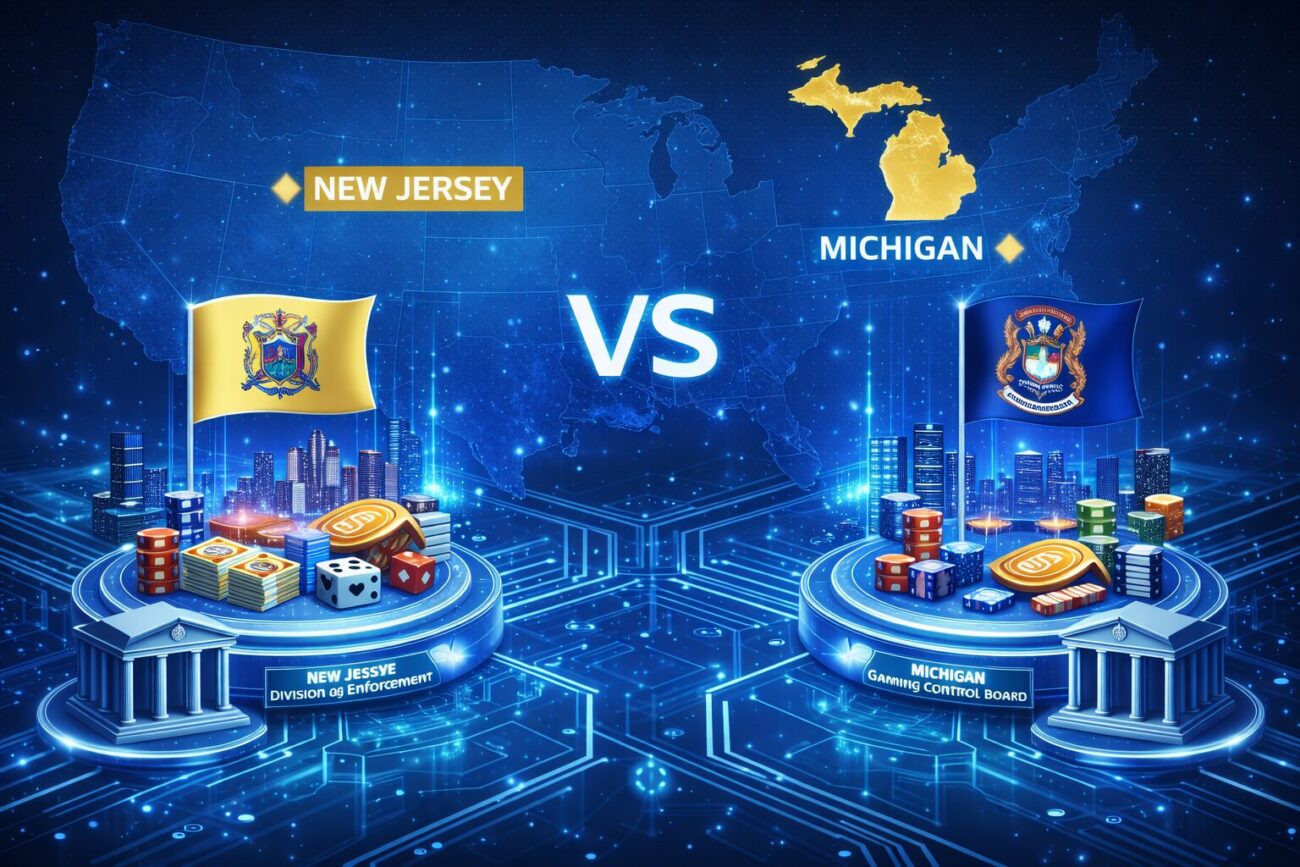
When people talk about regulated online casinos in the United States, New Jersey and Michigan are often mentioned together. Both operate large, legal iGaming markets, both license multiple operators, and both generate substantial tax revenue from online casino play. Look more closely, however, and the similarities begin to fade.
New Jersey and Michigan arrived at regulated online casinos from very different starting points, at different moments in time, and under different regulatory assumptions. New Jersey’s system emerged as an early experiment in adapting an existing casino framework to the internet. Michigan’s model was built later, informed by earlier state experiences and shaped by a broader modernisation of gambling law.
This piece looks deeper at both approaches to explore how regulatory design reflects history, timing, and institutional confidence.
TL;DR: New Jersey and Michigan both operate large, regulated online casino markets, but they arrived there through different paths. New Jersey launched early by extending its existing Atlantic City casino framework to the internet, refining rules over time through regulatory practice. Michigan legalised later, building a comprehensive online casino framework in statute from the outset, informed by lessons from earlier markets. Both systems work, but they reflect different regulatory philosophies shaped by timing, institutional history, and legislative confidence.
New Jersey: Extending an Existing Casino System Online
New Jersey’s move into online casinos did not begin with the internet. It began decades earlier, with the legalisation of land-based casino gambling in Atlantic City in 1976. By the time online gaming was considered, the state already had a mature regulatory apparatus, experienced oversight bodies, and a long track record of supervising casino operators.
When New Jersey authorised online casinos in 2013, it did so by extending that existing system rather than creating a new one from scratch. Internet gaming was framed as an additional channel for Atlantic City casinos, not as a separate industry. Licences were tethered to physical casinos, and operators were required to meet the same suitability and compliance standards that applied on the casino floor.
Oversight was placed firmly in the hands of the New Jersey Division of Gaming Enforcement, which already possessed deep institutional knowledge of casino operations. The regulatory challenge was not whether casinos should exist online, but how to ensure that online play could be confined within state borders, audited properly, and integrated into an established compliance regime.
This early launch came with uncertainty. Federal law around online gambling was still unsettled, geolocation technology was less mature, and there was no clear roadmap from other states to follow. New Jersey’s system evolved through iteration, technical refinement, and regulatory adjustment rather than through a single comprehensive statute.
Over time, that early start gave New Jersey a distinctive profile. Its online casino market is deeply integrated with land-based casinos, operational practices are conservative, and regulatory expectations are shaped by decades of prior casino oversight. Online casinos in New Jersey feel like an extension of an older industry, adapted cautiously to a new medium.
Michigan: Building a Modern Online Casino Framework Later
Michigan’s path was different in almost every respect. Unlike New Jersey, Michigan did not approach online casinos as an extension of a long-standing commercial casino hub. Instead, online casinos were introduced as part of a broader restructuring of the state’s gambling laws in the late 2010s.
Legislation authorising online casinos was signed in 2019, with regulated iGaming launching in early 2021. By that point, several other states had already entered the market, and key regulatory questions around geolocation, payments, and platform oversight had clearer answers. Michigan was able to design its system with the benefit of hindsight.
Oversight was assigned to the Michigan Gaming Control Board, which expanded its remit to include online casino operations. Unlike New Jersey’s casino-centric approach, Michigan’s framework was written explicitly to accommodate digital gambling alongside existing land-based and tribal gaming interests.
Michigan online casinos were authorised through a single legislative package that also addressed sports betting and online poker. While these verticals are distinct in operation, the shared legal foundation meant that Michigan’s online casino market launched with a clearer statutory basis and a more uniform regulatory structure than New Jersey’s early system.
Michigan’s model is notable for how quickly it reached scale. Because the market launched later, operators entered with more developed platforms, and regulators implemented requirements that reflected lessons learned elsewhere. The result is a system that feels modern by design rather than retrofitted from earlier casino law.
Different Regulatory Philosophies, Same Outcome
The contrast between New Jersey and Michigan is not about permissiveness versus restriction but rather regulatory philosophy shaped by timing.
New Jersey regulated online casinos cautiously, layering new rules onto an old framework and refining them over time. Michigan regulated online casinos deliberately, codifying expectations upfront in a comprehensive statute. Both approaches produced functional, regulated markets, but they feel different in practice.
New Jersey’s market carries the imprint of its origins. Licensing is tightly linked to Atlantic City, regulatory oversight reflects land-based casino traditions, and system design prioritises control and continuity. Michigan’s market reflects a later moment, where online casinos were treated as a first-class product rather than an adaptation.
Both states confine online casino play within state borders, rely on geolocation technology, and enforce strict compliance standards. Both prioritise consumer protection and regulatory oversight. The difference lies in how much was inherited versus how much was newly designed.
The Role of Sports Betting and Poker
Sports betting and online poker played different roles in each state, but they were not the primary drivers of online casino regulation.
In New Jersey, online casinos and poker launched together in 2013, with sports betting added later after federal restrictions changed. In Michigan, all three were authorised through a single legislative process, reflecting a more integrated view of online gambling.
In both cases, online casinos quickly became the dominant revenue source, overshadowing poker and, in many periods, even sports betting. This reinforces an important point. While headlines often focus on sports wagering, it is online casino gaming that anchors state-regulated iGaming markets in both states.
Two Models, One Structural Reality
New Jersey and Michigan illustrate how state authority shapes online casino markets in the absence of a national framework. One state moved early and refined its system over time. The other waited, legislated comprehensively, and launched with greater clarity.
Neither approach replaced the other. Instead, they demonstrate that regulated online casinos in the United States are products of local history, institutional capacity, and legislative timing. The end result may look similar from the outside, but the path taken matters for how each system operates.
Taken together, New Jersey and Michigan show that state-based regulation does not produce a single model of online casinos. It produces multiple stable systems, each shaped by when regulation occurred, how much experience regulators already had, and how willing lawmakers were to design specifically for the internet rather than adapt older rules.